

Is your content working for you, or are you just working for your content? A powerful digital marketing content strategy is the blueprint that turns random blog posts and social media updates into a predictable system for attracting, engaging, and converting customers. It’s about ensuring every video, article, and email you publish has a clear purpose and drives measurable results for your business.
Think of it as the strategic roadmap that connects your content directly to your bottom line. Without one, you're just creating noise. With one, you're building a growth engine.
Building Your Content Strategy From the Ground Up
Before you write a single word, you need a rock-solid foundation. Many businesses fall into the trap of chasing vague goals like "more website traffic." While that sounds nice, it's not specific enough to actually move the needle. A powerful content strategy starts by tying every effort back to a core business objective. This is what separates content that just fills space from content that delivers a tangible return on investment.
The goal isn't just to be seen; it's to be seen by the right people and guide them toward an action that helps your business grow.
Connect Content Goals to Business Revenue
First, you need to translate your company's ambitions into specific, actionable content goals. We always recommend using the SMART goal framework—that’s Specific, Measurable, Achievable, Relevant, and Time-bound. It forces you to get crystal clear on what success actually looks like.
Instead of saying, "I want to increase brand awareness," a better goal is, "Increase organic searches for our brand name by 20% in Q3."
Rather than, "I need more leads," aim for, "Generate 50 qualified leads for our home services division through our blog and email newsletter this month." See the difference?
Let's look at a couple of real-world scenarios:
- Business Objective: Increase sales for a new real estate development.
- Content Goal: Generate 100 tour requests from our video walkthrough series on social media and our website within 60 days.
- KPIs: Form submissions on the landing page, click-through rate from social ads, video view completion rate.
- Business Objective: Improve customer retention for a small business.
- Content Goal: Reduce customer churn by 5% over the next quarter by launching a value-packed monthly email newsletter.
- KPIs: Newsletter open and click-through rates, customer feedback surveys, and the churn rate itself.
By defining these connections upfront, you transform your content from a creative expense into a predictable growth engine. Every article, video, and social post becomes a calculated move designed to produce a specific, desired result.
This strategic mindset is critical. The content marketing industry is projected to become a $2 trillion global market by 2032. This tells us that brands are betting big on content. In fact, 92% of brands are boosting their investments in creator content, showing just how vital strategic creation has become for connecting with consumers.
Mapping Content Goals to Business Objectives
This table illustrates how specific content marketing goals directly support broader business objectives, helping you align your strategy for measurable impact.
| Business Objective | Corresponding Content Goal | Key Performance Indicator (KPI) |
|---|---|---|
| Increase Customer Lifetime Value | Reduce customer churn by 10% in 6 months | Churn Rate, Repeat Purchase Rate, Net Promoter Score (NPS) |
| Boost Lead Generation | Generate 200 qualified leads per quarter from gated content | MQLs, Lead-to-Customer Conversion Rate, Cost Per Lead |
| Drive E-commerce Sales | Increase online sales by 15% in Q4 | Conversion Rate, Average Order Value, Shopping Cart Abandonment Rate |
| Enhance Brand Authority | Become a top 3 search result for 5 core keywords | Organic Traffic, Keyword Rankings, Backlinks |
| Improve Customer Onboarding | Increase product adoption rate by 20% | Feature Usage Rate, Time-to-Value, Customer Support Tickets |
Ultimately, this alignment ensures your content team isn't just busy—they're being effective and contributing directly to what matters most.
Choosing Your Core Content Platforms
With clear goals in hand, the next question is where your content will live. Our advice? Don't try to be everywhere. It's a classic mistake. A focused approach is always more effective than spreading your resources too thin.
Your platform choices should come down to two simple things:
- Where does your target audience actually spend their time?
- Which content formats best match the goals you just set?
For most businesses, especially in local service or real estate sectors, a combination of owned platforms gives you the strongest foundation for growth.
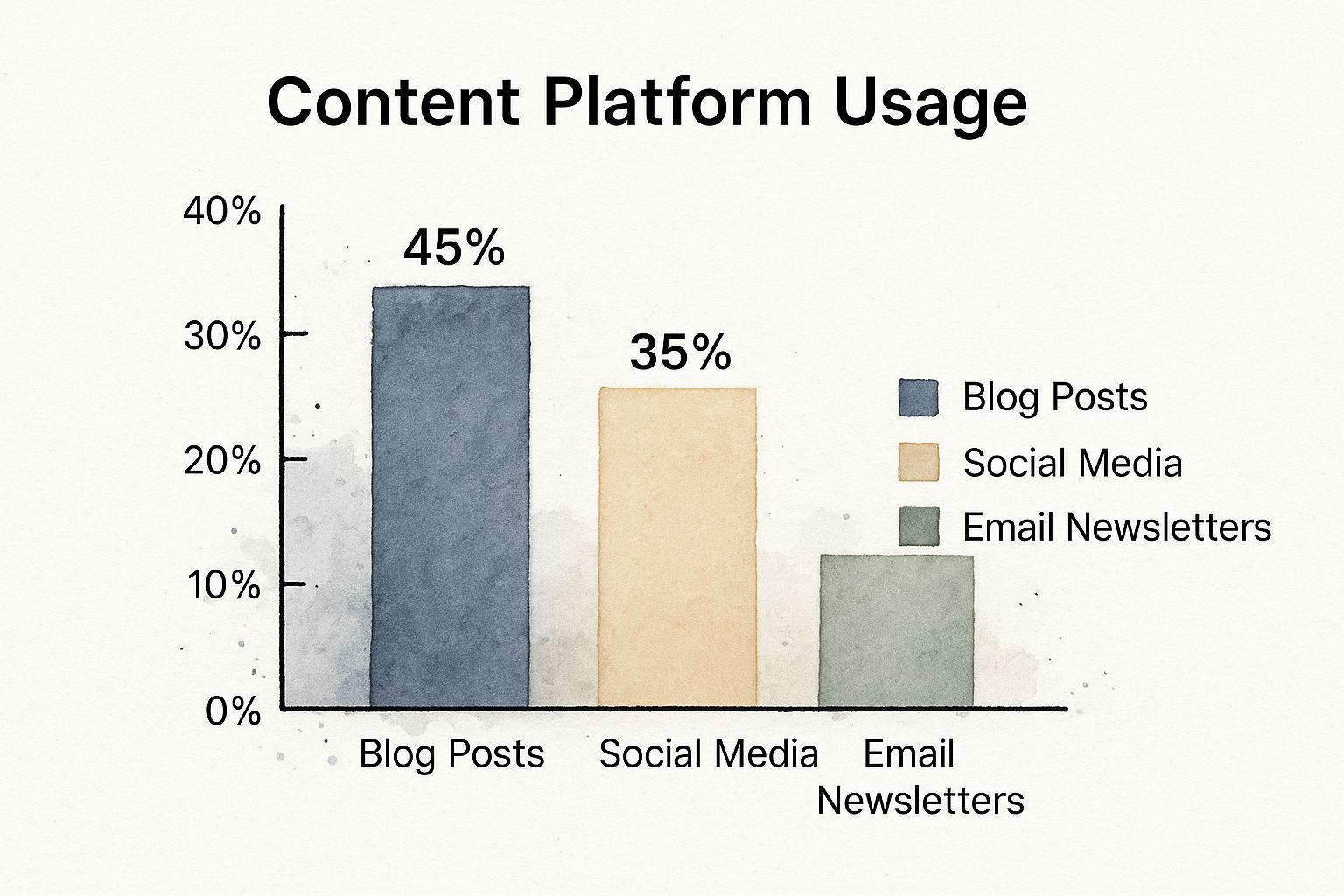
This data backs up what we see every day. While social media is a fantastic tool for amplification, a dedicated blog or resource center on your website is still the cornerstone for building authority and attracting high-intent organic search traffic.
When you pair that with a targeted email strategy, you create a powerful system for nurturing leads from initial interest to a final sale. Understanding how these channels work together is a core part of our approach to marketing with Adfuel, because it allows us to build a seamless and effective journey for your customers.
Truly Understanding Your Target Audience

Let's be honest: creating content without a crystal-clear picture of who you're talking to is like throwing darts in a dark room. You might get lucky, but it's a strategy built on hope, not results. A successful digital marketing content strategy is built on a deep, empathetic understanding of your audience.
We have to move past basic demographics like age and location. While that’s a starting point, it doesn't tell you why someone makes a decision. Real insight comes from digging into their challenges, their motivations, and the exact words they use when searching for solutions.
Going Beyond Basic Demographics
To build content that truly connects, you need to get inside your audience's head. It takes a bit of detective work, but the payoff is enormous. Your goal is to blend quantitative data (the what) with qualitative insights (the why).
Here are a few of the most effective ways to gather this kind of intelligence:
- Customer Surveys: Use a tool like SurveyMonkey or a simple Google Form to ask your existing customers targeted questions. We like to ask about their biggest challenges before they found us and what a "win" looks like for them now.
- One-on-One Interviews: Nothing beats a direct conversation. Spend 15 minutes on the phone with a few of your best clients. And just as importantly, talk to a few you recently lost. Ask open-ended questions like, "What was going on in your business that made you start looking for a solution like ours?"
- Social Media Analytics: Your social platforms are a goldmine of audience insights. Look at the demographics of who engages with your content, which posts get the most comments, and what questions people are asking.
- Competitor Research: Read the comments section on your competitors' blogs and social media pages. It’s an unfiltered look at your audience’s pain points and desires.
The most powerful content doesn't just answer a question; it speaks to the underlying emotion behind it. Is your audience feeling anxious, frustrated, ambitious, or just plain overwhelmed? Knowing this lets you dial in your tone and message for maximum impact.
When you start combining these methods, you'll see patterns emerge. You can then weave that exact language directly into your content, making your audience feel like you truly get them.
From Personas to Real People
Once you’ve done your research, it’s time to build out your buyer personas. A buyer persona is a semi-fictional character who represents your ideal customer. This isn't an academic exercise; it's about creating a tangible person you can write for.
Give your persona a name, a job title, and a backstory. For instance, a local realtor in Boca Raton might create a persona called "First-Time Buyer Felicity."
Example Persona: "First-Time Buyer Felicity"
- Background: She’s 32, a marketing manager, and recently engaged. She and her fiancé are tired of throwing money away on rent and want to build equity, but they're overwhelmed by the home-buying process.
- Core Challenges: She’s anxious about securing a mortgage, confused about closing paperwork, and terrified of overpaying in a competitive market.
- Motivations: She wants a safe neighborhood to start a family, a home with a yard for their dog, and to feel the pride of homeownership.
- Questions She Asks Google: "How much house can I afford?", "common mistakes first-time homebuyers make," and "best real estate agents for first-time buyers in Boca Raton."
Suddenly, you're not creating generic content about "real estate tips." You're writing a blog post titled "5 Ways to Overcome Home-Buying Anxiety in Boca Raton" specifically for Felicity. This level of focus is what separates a truly strategic content plan from a basic one.
Framing Insights with Jobs to Be Done
To take this a step further, we highly recommend applying the "Jobs to be Done" (JTBD) framework. The core idea is simple: customers "hire" products or services to get a specific "job" done.
For our "First-Time Buyer Felicity," the job isn't just "buy a house." The real job she's hiring a realtor for is "help me feel confident and secure in the biggest financial decision of my life."
This shift in perspective is a game-changer for your digital marketing content strategy. Your content becomes less about what you sell and more about the progress your audience is trying to make. You position your brand not as a vendor, but as a trusted guide.
How to Generate High-Impact Content Ideas
Now that you’ve set your goals and have a clear picture of your audience, it’s time for the fun part: brainstorming content ideas that connect with people and get them to act. A powerful digital marketing content strategy isn’t about waiting for inspiration; it’s about having a system for generating ideas that serve a real purpose.
The best ideas always live at the intersection of your expertise and your customer's most urgent questions.
Tap into Strategic Keyword Research
Keyword research is the bedrock of modern content, especially if you want to attract a steady stream of organic traffic. The real magic is in understanding the intent behind the search. Tools like Ahrefs and SEMrush are fantastic, but the mindset you bring is what matters most.
Put yourself in your customer’s shoes. What would "First-Time Buyer Felicity" actually type into Google?
- She’s not just searching for “real estate.” That's too broad.
- She’s digging deeper, asking things like, “how to save for a down payment” or “what credit score do I need to buy a house.”
These longer, more specific phrases—known as long-tail keywords—are content gold. They have less competition and signal that the searcher is serious. When you build content around these questions, you position yourself as the exact solution they're looking for.
Perform a Competitor Content Gap Analysis
Your competitors have done a lot of the hard work for you. A content gap analysis is simply a way to find valuable topics your competitors are ranking for that you aren’t. This is a proven shortcut to finding topics your shared audience already loves.
Here’s a simple way to do it:
- List 3-5 of your top competitors. Who shows up when you Google your most important services?
- See what's working for them. Use a tool like Ahrefs' "Top Pages" report to find which of their articles pull in the most organic traffic.
- Find the gaps—and the weaknesses. Look for relevant topics they cover that you haven’t. Even better, look for topics they've covered poorly. Can you create something more detailed, more current, or simply more helpful?
This isn't about copying. It’s about spotting an opportunity and creating a superior resource. If a competitor has a basic "10 Tips" post, you can create the definitive guide with video tutorials and a downloadable checklist.
Turn Customer Questions into a Content Goldmine
Your sales and customer service teams are on the front lines, fielding questions every single day. This is an incredible source of content ideas that most companies overlook.
Create a simple system for collecting these nuggets of wisdom, like a shared Google Doc or a dedicated Slack channel. Encourage your team to log real questions like:
- “What’s the actual difference between your ‘Standard’ and ‘Premium’ plans?”
- “How long does the installation process usually take, from start to finish?”
- “What are the most common mistakes people make when they try to do [your service] themselves?”
Every one of these is a perfect topic for a blog post, a short video, or a detailed FAQ page. Answering these questions publicly doesn’t just help future customers; it saves your team time and shows that your brand is transparent and genuinely helpful.
Map Ideas Across the Marketing Funnel
Not all content serves the same purpose. A smart digital marketing content strategy maps different ideas to each stage of the buyer's journey.
- Top of Funnel (Awareness): This is about broad, educational topics. Think "how-to" guides and checklists. For a realtor, this could be a guide on "The Best Family-Friendly Neighborhoods in Boca Raton."
- Middle of Funnel (Consideration): Here, you’re helping people evaluate their options. This is where case studies, comparison guides, and webinars shine. For example, using innovative digital content like virtual staging techniques can turn an empty listing into a compelling visual, helping potential buyers seriously consider a property.
- Bottom of Funnel (Decision): This content is direct and action-oriented: free consultations, live demos, and detailed service pages. A strong call-to-action like "Get a Free Home Valuation Today" is a perfect fit here.
By organizing your ideas this way, you ensure you have the right message ready at every step, guiding people from strangers to happy customers.
Managing Your Content Creation Workflow

A great idea is nothing without solid execution. Once you have a backlog of high-impact topics, you need to turn those ideas into great content, consistently and efficiently. This is where a documented content creation workflow becomes your most valuable asset.
Without a repeatable system, you invite chaos, missed deadlines, and inconsistent quality. A structured workflow minimizes bottlenecks and empowers everyone to deliver their best work on schedule.
Crafting the Perfect Content Brief
The entire process hinges on one critical document: the content brief. Think of it as the blueprint for your final piece. It’s the single source of truth that guides a writer, designer, or video editor to create exactly what you have in mind. A weak brief is a recipe for endless revisions.
A strong brief eliminates guesswork and is a non-negotiable first step. Your brief must include:
- Primary Target Keyword: The main search term you're aiming for.
- Secondary Keywords: Related terms to add semantic depth.
- Target Audience Persona: Who is this for, specifically? (e.g., "First-Time Homebuyer Felicity").
- Core Message & Angle: What's the one thing the reader needs to remember? What’s our unique take?
- Key Talking Points: A bulleted list of essential topics or questions to cover.
- Call-to-Action (CTA): What do we want the reader to do next?
- Inspiration & Competitor Links: Examples of what you love (and what you don't).
This initial investment of 15-20 minutes will save you hours of back-and-forth later.
Establishing a Clear Review and Approval Process
Once a draft is ready, it needs a clear, fast path to "published." A fuzzy review process is where good content goes to die.
Your goal is a streamlined system with defined roles and realistic timelines. For a small team, this might be a simple three-step process:
- Initial Draft Review (24 hours): The content lead reviews the piece for alignment with the brief, accuracy, and brand voice.
- Expert/Compliance Review (48 hours): A subject matter expert (or compliance officer for industries like real estate) does a quick check.
- Final Approval (24 hours): The content lead gives the final green light for publishing.
The key is to avoid "death by committee." Designate a single project owner who is responsible for consolidating feedback and making the final call. This keeps the process moving forward.
Developing Your Brand Style Guide
Consistency is everything in building a recognizable brand. Your voice and style should feel the same across every blog post, social media update, and email. A brand style guide is the rulebook that makes this happen.
This guide ensures everyone creating content for you—from a new hire to a freelancer—sounds like they're part of the same team. It’s the playbook for your brand's personality.
At a minimum, your style guide should define:
- Brand Voice & Tone: Are you authoritative and professional, or friendly and conversational? Is humor okay?
- Grammar & Formatting: Do you use the Oxford comma? How do you format titles and headings?
- Industry-Specific Terminology: A glossary of preferred terms to use (and which ones to avoid).
- Visual Guidelines: Rules for using logos, brand colors, and the style of your images.
A well-oiled workflow is what turns your strategy into a predictable, scalable engine for growth.
Amplifying Your Content for Maximum Reach
Creating stellar content is a huge achievement, but it’s only half the job. A brilliant blog post that nobody sees delivers zero value. This is where strategic content distribution and amplification come into play—the engine that gets your message in front of the right eyes.
The best amplification plan isn’t about blasting your content everywhere. It’s about making deliberate choices based on where your audience spends their time. A digital marketing content strategy that ignores distribution is fundamentally incomplete.
Choosing the Right Channels for Distribution
Your amplification channels should reflect your audience personas. A B2B service provider might focus on LinkedIn and email outreach. A local realtor, on the other hand, will find more traction on visually driven platforms like Instagram and Facebook.
A strong distribution plan includes a mix of owned, earned, and paid channels:
- Owned Media: Platforms you control completely, like your company blog, email list, and primary social media profiles. This is your foundation.
- Earned Media: When others share your content for you—guest posts on industry blogs, mentions from journalists, or organic shares. This builds immense credibility.
- Paid Media: Paying to promote your content, such as Meta ads, Google Ads, or sponsored posts. Paid amplification gives you control, precision, and speed.
The most effective strategies integrate these channels. A great blog post (owned) can be promoted with social media ads (paid) to attract new readers, who then sign up for your email list (owned), giving you a direct line to nurture them further.
The Power of Content Repurposing
Why spend days creating a comprehensive guide only to share it once? That’s a massive waste of effort.
Repurposing is the secret to maximizing your ROI. The idea is to take one substantial piece of content—a "pillar" asset—and break it down into dozens of smaller, bite-sized pieces for different platforms.
For example, a single in-depth guide on "First-Time Homebuyer Mistakes" could be repurposed into:
- Blog Excerpts: Turn each mistake into its own short blog post.
- Social Media Carousels: Create a visually engaging carousel for Instagram or LinkedIn that summarizes the key points.
- Video Shorts: Film a 60-second video for TikTok or Instagram Reels on the single biggest mistake.
- Podcast Segments: Dedicate a 10-minute segment of your podcast to discuss the emotional side of these mistakes.
- Email Drip Campaign: Create a 5-day email series that delivers one mistake and its solution to new subscribers each day.
This approach respects how people consume content on different platforms while consistently reinforcing your core message. It also creates a seamless user journey, a core principle of effective cross-channel marketing that builds brand recognition.
Leveraging Influencers and Social Proof
Modern consumers are increasingly turning to social media for discovery. The social ad market is expected to surge by 12% in 2025, and 59% of marketers are increasing their influencer partnerships to tap into this trend.
This makes sense when you consider that 76% of users say social content influences their buying decisions—a figure that skyrockets to 90% for Gen Z. Perhaps most tellingly, 41% of Gen Z now use social media over traditional search engines for information. You can discover more insights about digital marketing statistics on Marketing Dive. Partnering with credible influencers can introduce your brand to these highly engaged audiences in an authentic, trusted way.
Measuring Performance and Optimizing Your Strategy

A winning digital marketing content strategy isn’t something you “set and forget.” It’s a living system that must adapt to stay effective. The final—and most critical—part of the process is figuring out what’s working, what isn’t, and then optimizing your approach.
This continuous loop of feedback and refinement is what separates successful brands from those that fade away. Here, you circle back to those business objectives you set at the beginning. It’s time to look beyond vanity metrics like page views and social media likes.
Focusing on Metrics That Matter
To prove your content’s real value, you need to track KPIs that show tangible business impact. These are the numbers that get your leadership team’s attention.
Zero in on metrics like:
- Conversion Rates: What percentage of people who consume your content take the desired action (e.g., fill out a lead form, schedule a demo)?
- Lead Quality: Are the leads your content generates a good fit? A local realtor pulling in leads from out-of-state buyers has a high lead count but extremely low quality.
- Customer Acquisition Cost (CAC): How much are you spending—in content creation and promotion—to land a single new customer?
- Content-Driven Revenue: The holy grail of content KPIs. Can you draw a straight line from a specific blog post or video to a new sale?
By focusing on these business-centric metrics, you shift the conversation from "how many people saw our content?" to "how much revenue did our content generate?" This is how a marketing team earns a seat at the strategy table.
To get this right, you must be confident in your ability to connect marketing spend to results. Digging into the specifics of mastering marketing ROI measurement is non-negotiable for making data-backed decisions.
Conducting Regular Content Audits
A content audit is a systematic review of everything you’ve published. Think of it as spring cleaning for your website. It’s an essential practice for deciding what to keep, what to improve, and what to remove completely. We recommend doing a full audit at least twice a year.
Your audit should sort every piece of content using a simple framework:
- High-Performers (Keep/Promote): These are your all-stars. They rank well, bring in qualified leads, and get shared. Double down and promote them even more.
- Under-Performers (Update/Refresh): These assets have potential but need work. Maybe the data is outdated, the visuals are stale, or they need more strategic internal links.
- Low-Performers (Retire/Redirect): This is content that’s collecting dust. It's often better to delete these pages and redirect the URLs to a more relevant, high-performing asset to consolidate your SEO authority.
This process ensures your website stays lean and focused on performance. It’s also a golden opportunity to optimize your creative by analyzing what works best. This is where you can get sophisticated, exploring techniques like dynamic creative optimization to automate the process of finding the most effective creative combinations.
Got Questions? We’ve Got Answers.
As you build out your content strategy, a few common questions always pop up. Let’s tackle some of the big ones that business owners and marketing managers often ask.
How long until I actually see results?
This is the big one. While paid ads can deliver quick traction, a true digital marketing content strategy is a long game. Think of it like planting a tree, not flipping a switch.
Real, meaningful results in organic traffic and lead generation typically start to show up within 6 to 9 months. That’s the time it takes for your content to gain authority with search engines and start ranking for valuable keywords.
Is a content strategy the same as a content plan?
People often use these terms interchangeably, but they serve two very different functions.
- Your Strategy is the why. It’s your high-level vision—who you're talking to, what you want to achieve, and how your brand will stand out.
- Your Plan is the how and when. This is the tactical side, covering your content calendar, specific topics, formats, and where you'll post everything.
You can’t have an effective plan without a solid strategy guiding it.
What’s the right publishing cadence?
Consistency beats frequency, every time. It's far better to publish one incredible, deeply-researched article per week than it is to churn out three mediocre posts that don't help anyone.
Start with a publishing schedule you can realistically stick to without sacrificing quality. You can always scale up later.
Should I focus on new content or update old posts?
The smartest approach is a mix of both. Creating new content is how you target new keywords and expand your audience. It keeps your brand relevant and top-of-mind.
But don’t sleep on your existing content. Refreshing and updating your older "evergreen" articles is one of the most powerful and efficient SEO tactics out there. You can often get a significant rankings boost with far less effort than starting from scratch.
Ready to build a content strategy that delivers real business growth? Want to simplify your ad campaigns? Discover our fully managed Meta and Google Ads solutions. Book a free demo with us or send us an email at hello@goadfuel.com for more information.


