

In a market that feels more crowded by the day, using Facebook ads for insurance agents is still one of the most powerful ways to keep your pipeline full of qualified leads. But how do you connect with potential clients at the exact moment they’re thinking about their insurance needs, turning them from passive scrollers into genuinely interested prospects?
Why Facebook Ads Are an Agent's Best Friend
Old-school methods like cold calling don't pack the punch they used to. The digital world, however, gives you a direct line to your ideal clients. Many agents feel lost when it comes to social media ads, but the truth is, Facebook remains a powerful platform for client acquisition. It's not just about the sheer number of people on the platform; it's about the rich data that lets you engage with the right audience in a smart, compliant way.
Facebook is a top-tier choice for agents because its real magic is in the targeting. You can fine-tune your ads to reach specific groups, which is a game-changer when you’re selling nuanced products like health, life, or home policies. For a bigger picture of the competitive digital space agents are in, you can look at the discussion about a major online insurance comparison platform like Bjak.my.
The real power of Facebook ads lies in its ability to target people based on life changes, interests, and behaviors that signal an immediate need for insurance. Whether someone recently bought a home, had a baby, or started a business, you can reach them at the perfect moment.
The Modern Playbook for Success
This guide isn't about generic advice. This is the modern playbook for building a predictable lead generation engine. We’re going to focus on what really matters: turning prospects into policyholders by tackling the real challenges agents face right now.
Before we dive deep, let's get a high-level view of what a successful, money-making campaign actually looks like. These are the pillars you absolutely have to get right.
Key Pillars of a Profitable Insurance Ad Campaign
This table gives you a quick overview of the essential components we'll cover, showing you what it takes to build a successful campaign from the ground up.
| Pillar | What You Will Learn | Impact on Your Agency |
|---|---|---|
| Compliance First | How to navigate Meta’s “Special Ad Category” rules without getting your account shut down. | Ensures your ads run smoothly and protects your agency from compliance risks. |
| Compelling Creative | The art of creating visuals and copy that stop the scroll, build instant trust, and get the click. | Higher engagement, lower ad costs, and a stronger brand reputation. |
| Smart Targeting | Techniques for building high-value audiences using your data and compliant targeting options. | Attracts more qualified leads who are genuinely interested in what you offer. |
| Efficient Budgeting | How to set a realistic budget and track the metrics that matter, like Cost Per Lead and Cost Per Acquisition. | Maximizes your ROI and prevents you from wasting money on ineffective campaigns. |
| Nurturing System | The critical follow-up process required to turn a lead into a paying client. | Dramatically increases your conversion rates and grows your book of business. |
Getting a lead is only half the battle. By mastering these core pillars, you can shift from wondering if Facebook ads work to consistently generating high-quality leads that fuel your agency's growth. It's about building a system, not just running an ad.
Working Within the Special Ad Category for Insurance Ads
If you're running Facebook ads for insurance agents, there’s one rule you absolutely have to play by: the Special Ad Category. This isn't a minor setting you can ignore. It’s the entire framework Meta uses to govern how insurance is marketed on its platforms, and getting it wrong can shut your ads down fast.
Meta officially placed all insurance products under its Special Ad Category to prevent discriminatory advertising, which completely reshaped the targeting tools available to agents. For agents who built their business on hyper-specific demographic targeting, this felt like having their hands tied. But here's the thing: the best agents see it as a filter that forces everyone to get smarter about their marketing.
What This Actually Means for Your Campaigns
When you set up a campaign for an insurance product, you must declare it under the Special Ad Category. If you don't, your ad will get rejected, and you risk getting your entire ad account suspended.
Once you’re in this category, you’ll notice many of your old targeting options are gone. The platform restricts targeting based on characteristics that could be used, even unintentionally, for discrimination. The goal is to make sure opportunities like insurance are shown to everyone, not just a pre-selected group.
Here are the big restrictions you'll run into:
- No Age or Gender Targeting: Forget targeting the 50-75 age bracket for final expense. You can't target by gender, either. Your ads will be shown to everyone 18 and older, across all genders.
- Broad Location Targeting: The days of dropping a pin on a wealthy neighborhood are over. Location targeting is now limited to a minimum 15-mile radius around a city, county, or state. ZIP code targeting is also a no-go.
- Limited Detailed Targeting: A huge number of interest and behavioral targeting options—especially those related to income, financial status, or other personal attributes—have been removed.
These rules force a fundamental shift. You can't build an audience based on who someone is demographically. Instead, you have to focus on what they care about and the problems they're trying to solve.
Shifting from Demographics to Value-Driven Messaging
The secret to winning within these constraints is to stop thinking about targeting and start thinking about messaging. You can't tell Facebook to only show your ad to a 65-year-old in a specific suburb anymore. Instead, you have to write an ad so compelling that it stops the right person in their tracks, no matter who else sees it.
Think about the universal human needs that lead someone to look for insurance:
- Protecting their family if the worst happens.
- Having peace of mind in retirement.
- Leaving a legacy for their kids.
- Making sure their business can weather a storm.
These aren't age-specific or gender-specific issues. They're life issues. Your ad copy and creative now have to do the heavy lifting that your targeting used to do for you. It's all about making content that gets the right person to self-identify and say, "Hey, that's me."
The Special Ad Category forces you to lead with value, not assumptions. Your success is now directly tied to how well you understand your client's core problems and how clearly you can communicate your solution.
For instance, an old ad might have said, "Final Expense Insurance for Seniors." That's not compliant anymore because it implies an age group.
A much better, and fully compliant, ad would say: "Ensure Your Final Wishes Are Honored Without Burdening Your Family."
See the difference? The second headline speaks to a universal desire for dignity and protecting loved ones. It attracts the right audience based on their need, not their age. This is the mindset you need to adopt to win with Facebook ads today.
How to Craft Ad Creative That Actually Converts
You've navigated the compliance maze. Now for the part that actually gets you leads: your ad creative. This is the one thing your audience will see. In a feed flooded with generic stock photos and aggressive sales pitches, your mission is to be the one thing that stops the scroll. You need to build trust in a matter of seconds.

The days of just listing your services are long gone. Your ad copy has to speak directly to what keeps your prospects up at night. Instead of a flat "We sell auto insurance," try something like, "Tired of overpaying for car insurance? Let's find you better coverage at a price that makes sense." That simple shift shows you understand their motivations, like their search for how to get cheaper auto insurance.
The Power of Authentic Visuals
The image or video in your ad is the first thing people see. It can make or break your entire campaign. Forget the glossy, impersonal stock photos everyone else is using. People are craving authenticity.
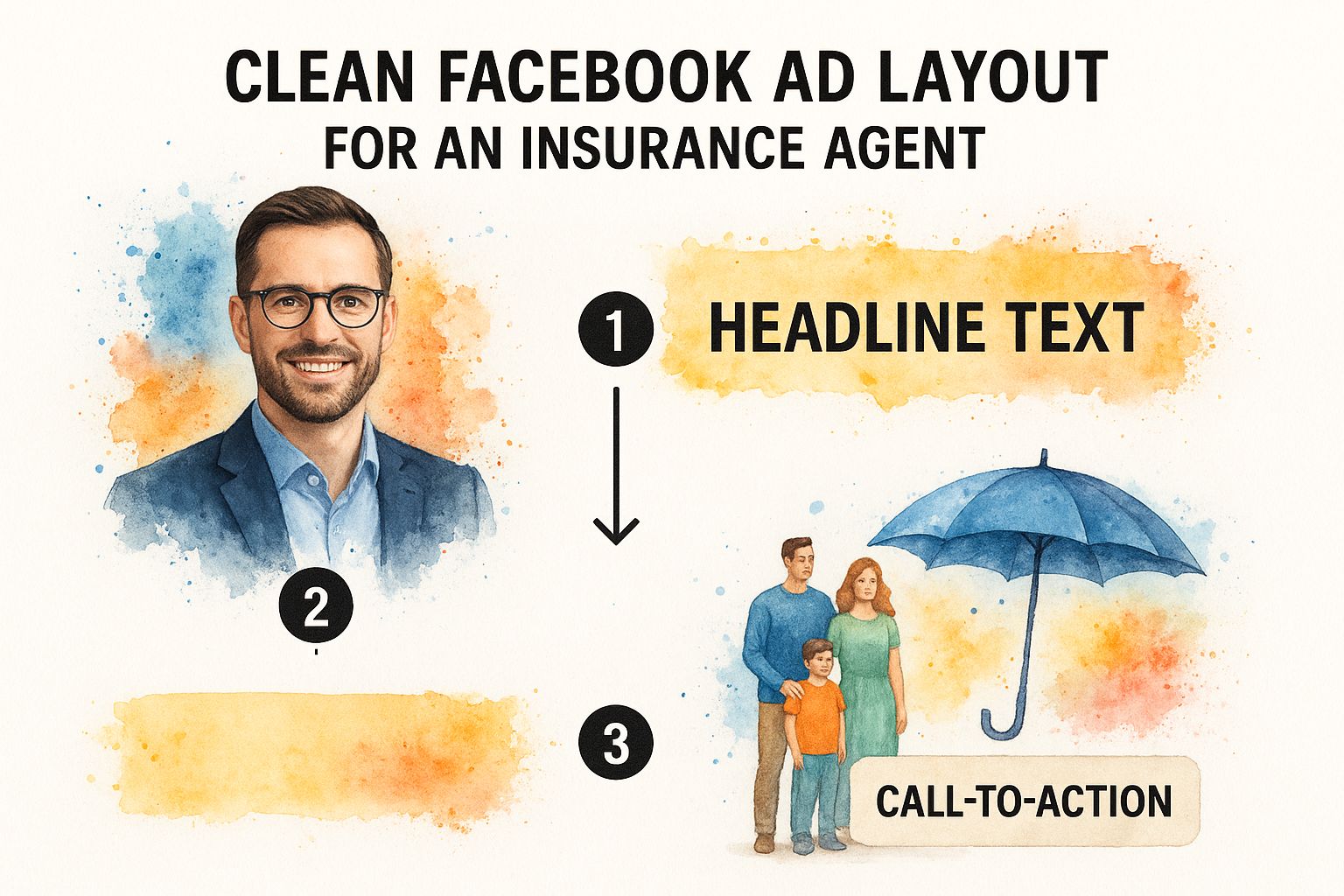
- Show Your Face: A professional but friendly photo of you or your team builds immediate trust. People want to buy from people, not a faceless logo.
- Use Video Testimonials: A short, genuine video from a happy client is the most powerful social proof you can get. It’s relatable, credible, and a thousand times more impactful than a written review.
- Create Simple Explainer Videos: Quick videos that bust common insurance myths or simplify a complex topic instantly position you as the expert. This "value-first" approach attracts much higher-quality leads.
Key Takeaway: Authentic visuals that feature real people—especially you and your happy clients—will always outperform generic corporate fluff. The goal is to be approachable and build a connection before you ever ask for their business.
The Anatomy of a High-Performing Insurance Ad
Every great ad, no matter the format, follows a similar blueprint. It’s a proven formula designed to grab attention, build interest, and push for a specific action.
- The Hook (Your First Sentence): You have about three seconds to stop someone. Kick things off with a question that hits a pain point or a bold statement that sparks curiosity.
- The Value Proposition (The Body): Get straight to the point. How do you solve their problem? Focus on the benefit, not the feature. Instead of, "We offer term life policies," say, "Protect your family's future for less than your daily coffee."
- Social Proof (The Credibility): Weave in a quick client quote, mention an award, or drop a key number (e.g., "Join over 500 local families we've helped secure their future.").
- The Call-to-Action (The Ask): Tell them exactly what you want them to do next. Make it clear and low-friction. "Get a Free Quote" is great for high-intent prospects, but "Download Our Free Guide" is perfect for nurturing leads who aren't quite ready. The expert team at Adfuel can help you design campaigns with compelling CTAs; learn more by exploring our approach to marketing with Adfuel.
Choosing the Right Ad Format for Your Goal
Not all ad formats are created equal. Your choice should directly tie back to your campaign's objective. The right format makes all the difference.
| Ad Format | Best For | Actionable Tip |
|---|---|---|
| Single Image Ad | Quick brand awareness and straightforward offers like a free quote. | Use a high-quality, authentic image of yourself or your team. Keep the text overlay minimal to comply with Facebook's guidelines. |
| Video Ad | Building trust, telling a client's story, or explaining a complex insurance product in a simple way. | Keep it short (15-30 seconds is ideal). Add captions, as a majority of users watch videos with the sound off. |
| Carousel Ad | Showcasing multiple insurance products (e.g., auto, home, life) or breaking down a process into simple steps. | Use each card to highlight a different benefit or feature, telling a mini-story that guides the user toward the final CTA. |
| Lead Form Ad | Capturing lead information directly on Facebook without sending users to a landing page. | Keep the form simple. Only ask for essential information (name, email, phone) to maximize completion rates. |
By thoughtfully combining authentic visuals, a proven copy structure, and the right ad format, you can create ads that not only follow the rules but also genuinely connect with your audience.
Building High-Value Audiences Compliantly
A killer ad creative is great, but without the right audience, you're just shouting into the void. Facebook ads for insurance agents live and die by their targeting.
When Meta rolled out the Special Ad Category, it took away many demographic tools. But it didn't kill our ability to find high-value prospects. It just forced us to get smarter, shifting our focus from personal attributes to user intent and behavior. The most powerful strategies start with the data you already have—your client list, website traffic, and social media engagement are goldmines for creating compliant, high-converting audiences.
Leverage Your First-Party Data with Custom Audiences
Let's start with your warmest leads. Meta's Custom Audiences tool is your best friend here. It lets you securely connect with people on Facebook and Instagram who already know who you are.
You can build incredibly effective Custom Audiences from a few key sources:
- Your Client List: Upload a list of current or past policyholders. Meta securely hashes the data, allowing you to run cross-sell campaigns (think auto clients who need life insurance), ask for referrals, or just stay top-of-mind.
- Website Visitors: Once you install the Meta Pixel on your site, you can create audiences based on specific actions. For example, you can build a retargeting list of everyone who visited your "Life Insurance" page but never submitted a quote form.
- Engagement Audiences: This is a list of people who have already interacted with you on Facebook or Instagram. You can target users who have watched your educational videos, liked your posts, or even opened (but not finished) one of your lead forms.
Scale Your Reach with Lookalike Audiences
So you've built a solid Custom Audience from your best clients. Now what? You clone them. That's essentially what a Lookalike Audience does. You feed it a high-quality source audience—like that list of your top policyholders—and Meta goes out and finds new people who share similar characteristics, behaviors, and online interests.
A Lookalike Audience built from your best clients is the single most powerful targeting tool available to insurance agents. You're essentially telling Meta, "Go find me more people just like my most profitable policyholders."
This is 100% compliant because you’re not manually picking the targeting parameters. You provide a quality data source, and the algorithm handles the rest. Start with a tight 1% Lookalike to find the closest matches, then experiment with broader audiences (2-5%) as you're ready to scale your campaigns.
Unlocking Compliant Interest Targeting
While many of the old interest categories are gone, plenty of valuable ones are still available. You just have to think differently—focus on affinities and behaviors, not direct demographics. Ask yourself: what do my ideal clients read, watch, or follow?
You can layer different interests to zero in on a more qualified audience.
- Publications: Target readers of financial publications like Forbes or The Wall Street Journal.
- Financial Interests: Use broader interests like "Financial planning," "Investment," or "Personal finance."
- Life Stage Proxies: You can't target "new parents" directly anymore. But you can target interests in popular parenting blogs, baby product brands, or family-focused media.
- Local Focus: Even with the mandatory 15-mile minimum radius, you can still center your campaigns on the specific cities where you do business. This is a crucial piece of any good location-based advertising strategy, making sure your budget is spent on relevant local prospects.
When you combine these three layers—Custom Audiences for retargeting, Lookalike Audiences for prospecting, and smart Interest Targeting for broader reach—you build a complete, compliant, and highly effective system for finding your next best clients.
Setting a Smart Budget and Measuring True ROI
Running Facebook ads for insurance agents without a clear financial strategy is a fast way to burn through cash. Let's break down the numbers so you can invest with confidence and actually see a return.
One of the first questions agents ask is, "How much should I spend?" There's no single magic number, but a smart place to start is $20 to $30 per day. That budget is just enough to let Meta’s algorithm gather meaningful data without breaking the bank while you're learning. Your initial goal isn't to get a flood of leads right away; it's to figure out your baseline Cost Per Lead (CPL).
Once you know what it costs to get a qualified lead, you can scale your budget predictably. If a good lead costs you $40 and you want five of them a day, you know you need a daily budget of $200. This is how you take the guesswork out of it.
Daily vs. Lifetime Budgets
When setting up a campaign, Facebook gives you two options:
- Daily Budget: This is your go-to for evergreen, ongoing campaigns. You tell Facebook to spend a consistent amount each day, which is perfect for generating a steady, predictable flow of leads.
- Lifetime Budget: This is a better fit for campaigns with a specific end date, like promoting a webinar or a special open enrollment offer. It gives Facebook more flexibility to spend your budget on days it thinks will get you better results.
For most insurance lead generation, a daily budget offers the control and predictability you need.
Choosing Your Bidding Strategy
Your bidding strategy tells Meta how to spend your money to get what you want. While there are a bunch of options, only two really matter when you're starting out.
- Highest Volume: When you first launch a campaign, this is where you want to be. It tells the algorithm to get you the most leads possible within your budget. This helps you collect performance data fast and lock down that initial CPL.
- Cost Per Result Goal: Once you have reliable data and you know a lead is worth, say, $50 to your agency, you can switch to this. You set your target CPL, and Meta will try to get you leads at or below that cost. This prioritizes stable costs over getting the absolute maximum number of leads.
The takeaway? Start with Highest Volume to learn, then graduate to Cost Per Result Goal to control your costs as you scale.
Don't get distracted by vanity metrics like reach or impressions. The only numbers that actually matter are the ones that connect directly to your agency's bank account.
Metrics That Actually Matter
Your Ads Manager dashboard can feel overwhelming, but only a few metrics tell the real story. Ignore the noise and focus on these Key Performance Indicators (KPIs):
- Cost Per Lead (CPL): This is your north star. It tells you exactly how much you're paying to get one person's contact information.
- Lead-to-Appointment Rate: This metric lives outside of Facebook. Of all the leads you generated, how many actually booked a meeting? A low rate here might mean your follow-up process has a problem, not your ads.
- Cost Per Acquisition (CPA): This is the ultimate measure of ROI. It’s your total ad spend divided by the number of new policies you actually wrote. Knowing your CPA is how you know if your campaigns are truly profitable.
By keeping a close eye on these three numbers, you can see the entire journey from a simple click to a paying client. That clarity is what lets you make smart, data-backed decisions that grow your business.
Turning Clicks Into Clients with a Nurturing System
A lead from your Facebook ads for insurance agents is just the start of a conversation. The hard work—and where you actually make your money—kicks off the second someone hits "submit" on your form. That gap between the click and the signed policy is where a rock-solid nurturing system proves its worth.
Without a plan, leads go cold almost immediately. The odds of making contact with a new lead plummet after just five minutes. Your follow-up has to be instant, consistent, and genuinely helpful if you want to turn that initial interest into a booked appointment.

The First Five Minutes Are Everything
Speed is the name of the game. The moment a lead comes in from Facebook, your system needs to fire off an immediate response. This isn't the time for a hard sales pitch; it's about acknowledging their request and setting the stage. An automated, initial SMS message is incredibly effective here.
A simple text like, "Hi [First Name], thanks for requesting a life insurance quote. This is [Your Name]. I'm looking over your info now and will give you a call from this number in a few minutes," does two crucial things. First, it confirms you got their request. Second, it primes them for your incoming call so it doesn't feel like a cold call.
Build Rapport on Autopilot
Not every lead is going to pick up the phone on the first try. This is where automated email and text sequences become your tireless assistant. The goal is simple: stay top-of-mind by providing value, not by spamming them.
A simple, effective nurturing sequence might look like this:
- Day 1: An immediate SMS followed by a welcome email introducing yourself and your agency.
- Day 3: Send an email with a link to a helpful blog post or a quick video busting a common insurance myth.
- Day 5: A friendly text checking in: "Hi [First Name], just wanted to see if you had any initial questions about the info I sent over."
- Day 7: Share a client testimonial in an email to build social proof and show you get real results for people.
This automated approach ensures no one ever slips through the cracks and quietly positions you as a trusted advisor, not just another agent.
Key Insight: A well-built follow-up system isn't about pushing a sale. It's about educating and building a relationship. When the time is right for them to make a decision, you’ll be the first person they call.
Your CRM is Your Command Center
Trying to manually track leads from Facebook in a spreadsheet is a recipe for disaster. To make this whole process run like a well-oiled machine, you must integrate your Facebook Lead Ads directly with your Customer Relationship Management (CRM) system.
This direct connection automatically pipes new leads into your system, kicking off the nurture sequences we just talked about. More importantly, it lets you track every single interaction—from the first ad click to the final policy sale. This gives you a crystal-clear picture of your campaign's true return on investment. Without a CRM, you’re flying blind.
Common Questions About Facebook Ads for Insurance
If you're just getting started with Facebook ads for insurance agents, you're bound to have some questions. We see the same ones pop up all the time, so let's clear the air and get you moving forward.
How Much Should an Agent Spend on Ads?
A solid starting point is $20-$30 per day. Think of this initial budget as an investment in data. Your goal is to figure out your profitable Cost Per Lead (CPL). Once you know what a quality lead costs your agency, you can confidently scale your daily budget based on how many leads you actually want each month.
Can I Target High-Net-Worth Individuals?
The short answer is yes, but not directly. You can't target by income level—that's a major compliance no-no. The smart way around this is to use compliant "proxy" interests. Ask yourself: what are the behaviors and affinities of affluent individuals? You can build audiences around interests in luxury car brands, high-end financial publications like Forbes or The Wall Street Journal, or even behaviors like "frequent international travelers."
Is a Quote or an Educational Guide Better?
This comes down to your objective. Neither one is "better"—they just serve different purposes.
- A "Free Quote" offer is a direct line to high-intent prospects who are actively shopping. The trade-off? You might attract more price-shoppers.
- An educational guide—like a "Retirement Planning Checklist"—attracts people earlier in their research phase. These leads often take more nurturing, but they tend to be higher quality because you've already started building trust by providing value. A truly effective strategy runs campaigns for both.
Ready to stop guessing and start generating a predictable flow of high-quality insurance leads? The team at Adfuel builds and manages data-driven ad campaigns that get results. Want to simplify your ad campaigns? Discover our fully managed Meta and Google Ads solutions. Book a free demo with us or send us an email at hello@goadfuel.com for more information.


