

Is your digital ad spend actually driving results, or is it just draining your budget? Answering that question starts with understanding one core metric: Cost Per Click (CPC). While the formula itself is simple, knowing how to calculate CPC is the first step toward transforming your ad campaigns from an expense into a profitable investment.
This guide breaks down the CPC calculation, explores the factors that influence your costs, and shows you how to find the sweet spot for a positive return on ad spend.
The Simple Formula to Calculate CPC
At its core, the formula to calculate CPC is straightforward: Total Ad Spend / Total Clicks.
Every dollar you invest and every click you earn feeds into this foundational metric. It’s the backbone of pay-per-click (PPC) advertising for a reason—it measures cost efficiency at the most granular level.
For instance, 2023 data from Business of Apps shows the average CPC for Google Search Ads was around $3.09, while Google Display Ads were significantly cheaper at $0.72 per click. This difference highlights how platform and user intent dramatically impact what you pay.
Breaking Down the Formula
Let's apply this to a real-world scenario. Imagine a local realtor in Boca Raton runs a Facebook ad campaign to promote a new luxury home listing.
Here are the campaign numbers:
- Total Ad Spend: $500 over one week.
- Total Clicks: The ad generated 250 link clicks to the property's landing page.
Using the formula, the calculation is: $500 (Total Cost) / 250 (Total Clicks) = $2.00 CPC.
It's that simple. The realtor paid exactly $2.00 every time a prospective buyer clicked to view the listing.
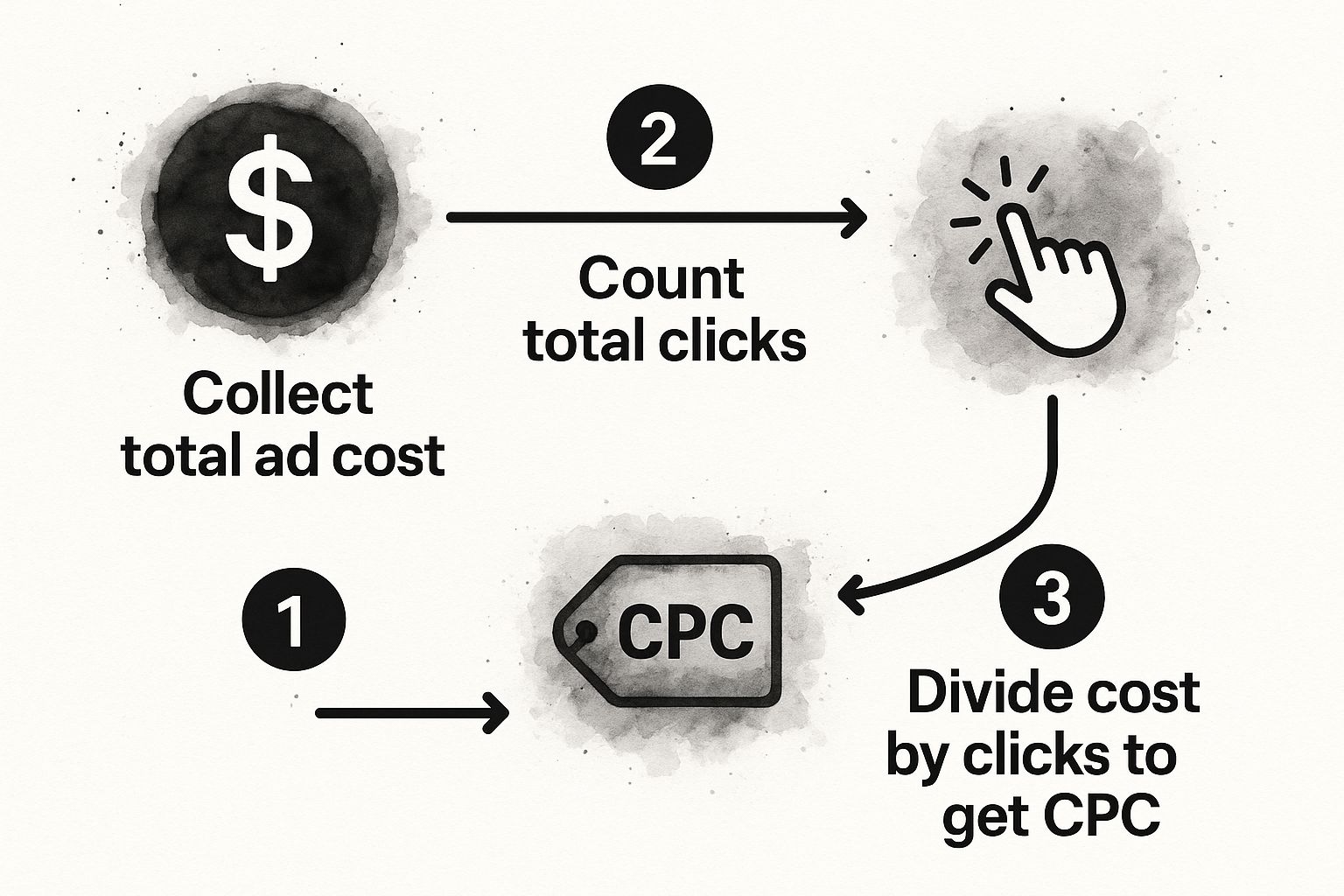
This number is your baseline performance indicator. While a $2.00 CPC could be a fantastic deal for a high-value real estate lead, it would be far too expensive for a local business selling low-margin products. Context is everything.
CPC Formula Components at a Glance
To ensure we're aligned, here’s a quick breakdown of the formula's components. Getting these numbers right is crucial for accurate analysis.
| Component | Definition | Example Value |
|---|---|---|
| Total Cost | The complete amount spent on an ad or campaign over a specific period. | $500 |
| Total Clicks | The total number of clicks your ad received during that same period. | 250 |
| CPC | The final calculated cost for each individual click. | $2.00 |
This table simplifies it to the essentials: you take your total investment, divide it by the interactions you paid for, and get your cost per interaction.
At the end of the day, CPC is a measure of cost efficiency. It tells you exactly how much you're paying to capture someone's attention and bring them to your website or landing page.
The key is to view this metric not just as a cost, but as an investment. Each click represents a potential customer, and your CPC tells you how much you’re investing to start that conversation.
What Actually Drives Your Ad Costs
Knowing the CPC formula is a great start, but true optimization comes from understanding what pushes that number up or down. Your ad costs aren't random; they are the result of a massive, real-time auction where platforms like Google and Meta reward quality and relevance.
These platforms are designed to provide the best user experience. When your ad is a perfect match for what someone is searching for, the platform rewards you. This often means better placement and, crucially, a lower CPC.
The Role of Quality Score and Ad Relevance
In the Google Ads ecosystem, this concept is encapsulated in a metric called Quality Score. It’s a rating from 1 to 10 based on your ad copy, keyword relevance, and landing page quality. A high Quality Score signals to Google that you’re providing value, and they often reward you with a significant discount on your CPC.
On the Meta platform (Facebook & Instagram), you’ll find a similar concept in their Ad Relevance Diagnostics. These metrics assess your ad's quality, engagement, and conversion potential against others competing for the same audience. High relevance means you're a good fit, which helps drive down your costs.
This is precisely why two different businesses bidding on the exact same keyword can end up paying wildly different amounts for a click.
Competition and Bidding Strategy
Of course, the auction environment itself is a huge factor. The more advertisers vying for the same keywords or audience, the higher the cost. If you’re a personal injury lawyer or in the insurance industry, you’re operating in some of the most expensive digital ad markets.
High competition naturally inflates bid prices as everyone competes for a limited number of ad slots. This is where your bidding strategy becomes critical. You can set a maximum CPC bid to cap your spending, but you must always be mindful of what your competitors are doing.
A low CPC isn’t the ultimate prize. The real goal is a cost-effective CPC that brings in high-quality traffic and generates a positive return on your investment.
Strategic Levers You Can Pull
Beyond quality scores and bidding wars, several levers are under your direct control. Smart adjustments here can stretch your budget significantly.
- Geographic Targeting: Costs can vary massively by city, state, or even zip code. A real estate agent advertising in Miami will pay a much higher CPC than one in a small, rural town.
- Ad Scheduling: Running ads 24/7 is rarely the most efficient approach. If your home services company only answers calls from 9 to 5, schedule your ads to turn off overnight to save money on clicks that come in at 2 a.m.
- Device Optimization: Are your best leads calling from their phones or filling out forms on a desktop? Analyze your data and adjust your bids to prioritize the device that is actually generating revenue.
All these factors work in tandem, which is why CPC only tells part of the story. Our entire approach to marketing with Adfuel is built around optimizing these variables—not just to get clicks, but to drive truly profitable growth.
Finding Your CPC in Google and Meta Ads
Knowing the CPC formula is one thing, but the real power comes from pulling that data directly from your ad platforms. Both Google Ads and Meta Ads provide this information, but it can sometimes feel buried in their dashboards.
Let's cut through the noise and pinpoint exactly where to look. Think of these dashboards as your mission control for campaign efficiency. Regular checks allow you to spot trends, fix issues, and make data-driven decisions instead of guessing where your money is going.
Locating Average CPC in Google Ads
Inside your Google Ads account, the primary metric is Average CPC (Avg. CPC). This number is exactly what it sounds like: the average amount you’re charged each time someone clicks your ad. It’s calculated by dividing your total ad cost by the total number of clicks.
You can find this metric front and center in your main performance table.
- Navigate to the Campaigns, Ad Groups, or Keywords tab.
- Scan your data table for the "Avg. CPC" column.
- If you don't see it, simply click the Columns icon, select Modify columns, and add "Avg. CPC" from the Performance category.
This is the command center for any Google Ads campaign, giving you a high-level view of what's working.
From here, you can quickly see the core metrics—clicks, impressions, and cost—that feed directly into your average CPC.
Finding Cost Per Result in Meta Ads
Meta Ads Manager approaches things a bit differently, often focusing on "Cost per Result," which varies based on your campaign objective. If you're running a traffic campaign, the key metric is Cost per Link Click. This is Meta's equivalent of CPC when your goal is to drive people to your website.
Pro Tip: A common rookie mistake is confusing "Cost per Link Click" with "Cost per Click (All)." The "(All)" metric is deceptive—it includes clicks on any part of your ad, such as likes, shares, or profile visits. Those interactions don't send traffic to your site. For measuring website traffic efficiency, always focus on Cost per Link Click.
Just like in Google Ads, you can customize your columns in Ads Manager. Find the "Columns" dropdown, choose "Customize Columns," and add "Cost per Link Click" to your dashboard. This ensures you're tracking the most important cost metric without distractions.
What Is a Good Cost Per Click Anyway?
Every marketer eventually stares at their dashboard and asks the inevitable question: "Is my CPC actually good?"
The honest answer is always: it depends. A "good" CPC isn't a universal number you can find on a chart. It’s a dynamic target defined by your industry, your campaign goals, and what a single click is genuinely worth to your business.
It All Starts With Your Industry
For example, businesses in the legal or financial services space will see some of the highest CPCs. Why? A single new client could be worth thousands in lifetime value, making a higher cost per click a worthwhile investment.
On the other hand, an e-commerce store selling t-shirts needs a much lower CPC to remain profitable due to smaller margins. A real estate agent in a competitive market like Miami might find a $2.50 CPC to be a bargain if it brings in even one qualified lead.
Average CPC by Industry: A Benchmark Comparison
Average Cost Per Click varies significantly across different industries, which helps businesses set realistic expectations for their ad spend.
| Industry | Average CPC (Example) | Reason for Cost |
|---|---|---|
| Legal Services | $6.00+ | High-value clients, intense competition for keywords like "attorney" or "lawyer." |
| Finance & Insurance | $3.77 | High customer lifetime value (LTV) justifies a higher acquisition cost. |
| Real Estate | $2.50 | Commissions are substantial, making each qualified lead extremely valuable. |
| Apparel & Retail | $0.45 | Lower-priced items and smaller margins require a highly efficient CPC. |
| Travel & Hospitality | $1.50 | Moderate value per booking, but competition is fierce for popular destinations. |
As you can see, what's considered "expensive" in one industry is a bargain in another. Context is everything.
Your Campaign Goals Define Your CPC
Beyond your industry, the purpose of your campaign is a critical factor. Are you trying to make a sale now, or are you building brand awareness?
- Brand Awareness: For these campaigns, the goal is reach and impressions. A lower CPC is ideal because you want your budget to stretch as far as possible to get your message in front of a large audience.
- Lead Generation: When you're seeking qualified leads—like a mortgage broker looking for home buyers—you should be willing to pay a higher CPC. A $5.00 click that turns into a commission is a massive win. Understanding how different creative formats and ad sizes attract the right attention can make or break your campaign.
Ultimately, a good CPC is one that delivers a positive Return on Ad Spend (ROAS). If you’re spending $3 per click but those clicks are generating $30 in revenue, you have a fantastic CPC. End of story.
Chasing a low CPC just for the sake of it is a common mistake. Cheap clicks from an audience that will never buy are worthless. Your real job is to find the sweet spot where your cost is sustainable and drives measurable growth for your business.
Common CPC Mistakes That Are Wasting Your Budget
Calculating your CPC is a good start, but where advertisers truly lose money is by misinterpreting what that number means. Several common, avoidable mistakes can turn your ad spend into a sunk cost instead of a strategic investment. Let's walk through them so you can steer clear.
The most frequent error is chasing a low CPC at all costs. It's an easy trap. A realtor, for instance, might get excited about a $0.50 CPC but then wonder why none of those clicks are turning into leads.
Here's the hard truth: cheap clicks are worthless if they come from a low-intent audience with no interest in buying.
A "good" CPC is one that leads to a profitable conversion. A high-quality click that costs $5.00 but generates a $500 sale is infinitely better than ten cheap clicks that generate nothing.
This obsession with vanity metrics often goes hand-in-hand with confusing CPC with other key performance indicators like CPA (Cost Per Action) or CPM (Cost Per Mille). Each metric tells a different part of your campaign's story. Mixing them up will derail your analysis and lead to poor strategic decisions.
Overlooking Lead Quality And Conversion Rates
Focusing only on CPC without looking at traffic quality is like filling a restaurant with people who only want free water. You must connect your CPC to your conversion data. Are those clicks actually turning into phone calls, form fills, or sales?
- Track Beyond the Click: Implement conversion tracking to see what happens after someone lands on your page.
- Analyze Your Lead Sources: Dig into your data to identify which campaigns, ad groups, or keywords are bringing in the clicks that actually convert.
- Optimize for Real Value: Once you know what's working, adjust your bids to prioritize that valuable traffic—even if it comes with a higher initial CPC.
When you analyze the full picture, you can invest in the clicks that actually move the needle. A strong ad campaign can also boost brand recognition, which often leads to more direct searches down the road. Pairing your ads with a solid search engine optimization (SEO) strategy creates a powerful synergy that lifts your entire online presence.
Common Questions About Calculating CPC
Even with a firm grasp of the CPC formula, real-world application often brings up new questions. Here are the answers to the questions we hear most often from realtors, local service providers, and marketing managers.
Does a Lower CPC Always Mean a Better Campaign?
Not at all. While a low Cost Per Click can feel like a win, it’s often a vanity metric. A rock-bottom CPC can be a red flag, signaling that you're bidding on low-competition, low-intent keywords that don't attract serious buyers. The real goal isn’t cheap clicks; it’s finding a cost-effective CPC that pulls in high-quality traffic and qualified leads. Success is measured by your return on investment, not by how little you paid for a website visit.
The smartest campaigns strike a balance. They’re willing to pay a higher CPC for the right keywords and audiences because they know those clicks have a much better chance of turning into real revenue.
How Often Should I Check My CPC?
For active campaigns, monitor your CPC daily or every few days. This quick check helps you spot sudden cost spikes or performance dips before they burn through your budget. It’s the best way to catch new competitors entering the auction or shifts in market demand. That said, avoid making knee-jerk changes based on one bad day. Ad performance fluctuates. To make smart, strategic decisions about bidding and budgeting, you need to analyze trends over a full week or longer.
Why Is My CPC Higher Than the Industry Average?
Several factors can drive your CPC above industry benchmarks. It’s almost never just one thing. The usual suspects include:
- Tough Competition: You might be in a crowded local market, like a real estate agent in a major city where everyone is bidding on the same terms.
- Expensive Keywords: High-intent keywords that signal a user is ready to buy will naturally cost more.
- Lower Ad Quality: Platforms like Google reward relevance. If your ads have a low Quality Score or relevance score, the platform will charge you more per click to show them.
Think of a high CPC as a diagnostic tool. It’s a signal to investigate your campaign, from your keyword targeting to your ad copy and landing page experience.
You’ve Calculated Your CPC… Now What?
Knowing how to calculate your CPC is just the starting line. The real value comes when you use that number as a tool for strategic growth, turning a simple data point into real-world results.
Think of your CPC as a health report for your ad campaigns. It tells a story about your ad quality, targeting precision, and competitive standing. A "good" CPC isn't a universal number—it's one that delivers a solid return on investment for your business.
Use your cost-per-click insights to continuously refine your approach. A high CPC might mean your ad copy isn't resonating or your targeting is too broad. A low CPC might seem great, but are those clicks actually converting? This is how you transform CPC from a simple expense into a powerful lever for trimming wasteful spend and maximizing your results.
Ultimately, every click is an opportunity. When you master your CPC, you’re making sure every dollar you spend is working hard to bring in high-quality leads and drive your business forward.
Want to simplify your ad campaigns? Discover our fully managed Meta and Google Ads solutions. Book a free demo with us or send us an email at hello@goadfuel.com for more information.


