

If you want to get more real estate leads, you have to stop chasing random contacts and start building a digital foundation that attracts qualified prospects. That means getting laser-focused on your ideal client, creating a website that converts, and owning your local search results.
Success isn't about getting more leads; it's about attracting the right leads from the very beginning. This guide will walk you through the foundational, paid, and organic strategies that top-producing agents use to build a predictable and profitable lead pipeline.
Build Your Foundation for High-Quality Leads
Before you spend a single dollar on ads, you need a powerful digital foundation. Many agents overlook this step, which is like building a house on sand—it won’t last. Casting a wide net and hoping to catch anyone is a recipe for wasted time and money. The key is to attract your ideal client from the moment they first interact with your brand.
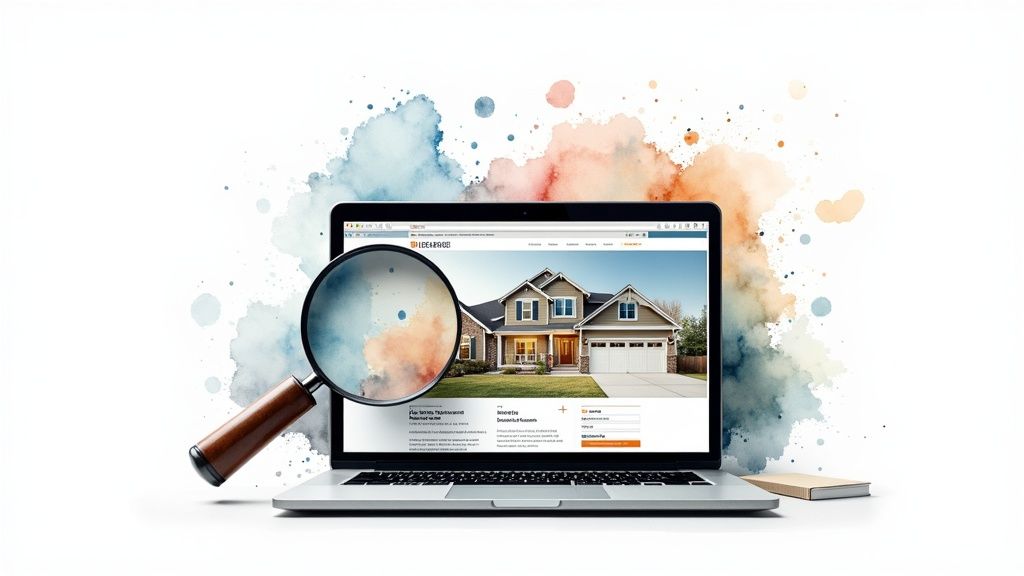
This process starts by getting far more specific than "buyers" or "sellers." For instance, a realtor in Miami shouldn't just target 'homebuyers.' A more effective strategy would be to target 'millennial first-time homebuyers in the Brickell area looking for condos under $750k.' This level of detail transforms your marketing from a shotgun blast into a laser-guided missile.
Define Your Ideal Client Avatar
Creating a client avatar will guide every marketing decision you make, from the ad copy you write to the layout of your website.
Get granular and think about:
- Demographics: What is their age, income, and family status? A young professional couple has different priorities than a retiree looking to downsize.
- Location: Pinpoint the exact neighborhoods, zip codes, or even the school districts they care about most.
- Motivations: What are their biggest pain points? Are they stressed about affordability, focused on school ratings, or trying to find a building that allows their pets?
- Online Behavior: Where do they spend time online? Are they scrolling Instagram, searching on Google, or active in hyper-local Facebook groups?
Once you have this clear picture, you can craft messages that speak directly to their problems and goals, making your brand instantly more relevant. This groundwork makes your ad spend more efficient and connects you with the right people.
Optimize Your Digital Storefront
Your website and online profiles are your 24/7 sales engine. They must be polished, professional, and built to turn visitors into contacts. This includes a mobile-first website with clear, impossible-to-miss calls-to-action (CTAs) like "Schedule a Showing" or "Get Your Free Home Valuation."
Equally important is your Google Business Profile (GBP). For many potential clients, this is their first impression of you. A fully optimized profile with recent photos, glowing reviews, and up-to-date information is non-negotiable for capturing local search traffic.
This setup is critical because lead conversion is a long game. Real estate experts estimate that only 3-6% of contacts in an agent's database are actively looking to buy or sell at any given time. This statistic highlights why you need a system that not only captures leads but also nurtures them until they're ready.
This foundational work prepares you to effectively capture and convert the leads your marketing efforts will generate. For a deeper dive, check out our guide on real estate marketing solutions to see how a powerful online presence can transform your pipeline.
How to Get More Real Estate Leads with Paid Ads
While organic growth is a long-term strategy, paid advertising is your tool for generating a predictable stream of real estate leads right now. Platforms like Meta (Facebook and Instagram) and Google Ads allow you to place your message directly in front of your ideal clients with incredible precision.
This isn't about aimlessly "boosting" a post. It's about building a strategic system that methodically turns ad spend into appointments on your calendar.

The image above shows the starting point for a high-intent Google Ads campaign, where you can intercept people actively searching for a real estate agent. When executed correctly, you create a lead generation machine that works for you 24/7.
Choose Your Objective Wisely
The first step in any ad campaign is to define your goal. This choice dictates how the platform's algorithm finds people for you, optimizing delivery to find users most likely to perform your desired action.
While a "Traffic" campaign might be useful for getting initial eyeballs on a new website, you must graduate to higher-intent objectives to generate leads.
- Lead Generation Campaigns: This is your primary tool. Available on both Meta and Google, these campaigns are designed to capture contact information with minimal friction. Users can often fill out forms pre-populated with their profile data, which significantly boosts conversion rates.
- Sales/Conversions Campaigns: This is a more advanced strategy that tracks specific actions on your website, like a "Contact Us" form submission. It requires setting up tracking pixels (e.g., the Meta Pixel), but the resulting leads are typically of much higher quality.
By choosing a high-intent objective, you are instructing the platform to find contacts, not just clicks.
Use Hyper-Local Targeting to Find Ideal Clients
Paid ads allow you to move beyond blanketing an entire city and instead surgically target the exact people who fit your ideal client profile.
Let's say you're an agent in Boca Raton specializing in luxury waterfront homes. Instead of wasting money on the entire city, you could build a laser-focused audience:
- Location: Target specific affluent zip codes, like 33432 and 33487.
- Demographics: Focus on users aged 45-65+ with income levels in the top 10% of U.S. zip codes.
- Behaviors & Interests: Layer in interests like "luxury real estate," "yachting," and "golf." You can even target users whose online behavior indicates recent visits to Zillow or Realtor.com.
This level of precision ensures your ad budget is spent only on prospects genuinely interested in what you offer.
PPC Platform Comparison for Real Estate Leads
| Feature | Meta Ads (Facebook/Instagram) | Google Ads (Search) |
|---|---|---|
| Primary Use Case | Demand Generation: Finding potential clients before they've actively started searching. Ideal for "Just Listed" ads, branding, and community building. | Demand Capture: Intercepting users who are actively searching for an agent or property with high-intent keywords like "realtors in [your city]." |
| Targeting | Based on demographics, interests, and behaviors. Target by age, income, life events (e.g., "likely to move"), and interests (e.g., "luxury goods"). | Based on keywords and user intent. You target what people are typing into the search bar, making it highly effective for capturing motivated prospects. |
| Expected Outcome | Generates a higher volume of leads, often at a lower Cost Per Lead (CPL). These leads may require more long-term nurturing. | Generates fewer but higher-quality leads. These prospects are typically further along in their journey and ready to speak with an agent. |
In short, use Meta to build your audience and fill the top of your funnel, and use Google to capture prospects who are ready to take action.
Crafting Ad Creative That Converts
Your ad creative—the image, video, and text—must be compelling enough to stop the scroll and earn a click. Generic stock photos and bland headlines are a waste of money. You need visuals and copy that connect with a user's goals and pain points.
Here are a few proven ad formulas for real estate agents:
- Video Walkthroughs: A 30-60 second video tour of a new listing provides an authentic feel for the home and helps build a personal connection.
- 'Just Listed' Carousels: Use a carousel ad to showcase 5-7 stunning photos of a new property, with each card highlighting a key feature like the kitchen or backyard.
- Market Update Graphics: Create a simple, branded graphic with a compelling local statistic, such as: "Home Prices in The Heights Are UP 12% Year-Over-Year! Find Out Your Home's New Value."
Your ad copy must be equally sharp. Avoid generic phrases and instead use language that sparks curiosity or creates urgency.
- Headline Example: "See What Your Neighbor's Home Just Sold For"
- Body Text Example: "Curious about your home equity? Get a free, no-obligation valuation from a local market expert. Click to find out your new home value in under 60 seconds."
Demystifying Budgets and Key Metrics
You don't need a massive budget to achieve results. Many agents find success starting with just $15-$25 per day. The key isn't how much you spend, but the return you get on that spend.
To measure effectiveness, track these key metrics:
- Cost Per Lead (CPL): This tells you exactly what you're paying to acquire one new contact. A good CPL can range from $10 to $50, depending on your market's competitiveness.
- Click-Through Rate (CTR): This shows the percentage of people who see your ad and click on it. A high CTR indicates your creative and targeting are resonating.
- Conversion Rate: This is the percentage of people who click your ad and then complete your lead form. A low conversion rate may signal an issue with your landing page or offer.
Finally, always be testing. A/B testing, or running two slightly different versions of an ad, allows you to see which headline, image, or call-to-action performs better. These methodical tweaks can lead to significant improvements in your CPL.
Turn Your Website Into an Organic Lead Machine
Paid ads generate immediate leads, but your website is the engine for sustainable, long-term growth. Think of it as your most valuable digital asset—a 24/7 lead capture system that works for you even when you're not online. Organic strategies build an asset that pays dividends for years, attracting motivated clients without a constant ad spend.
The goal is to transform your site from a simple online brochure into a high-value resource that prospects genuinely want to use.

Build High-Value Landing Pages
Standard "Contact Us" forms are passive. To generate organic leads effectively, you must offer something valuable in exchange for a prospect's information. This is where dedicated landing pages, or "lead magnets," come into play.
These pages are designed with a single goal: to capture a lead by offering a resource that solves a real problem for your ideal client.
Here are a few proven ideas for landing pages that convert:
- Free Home Valuation Tool: Homeowners are always curious about their property's value. A "Free [Your City] Home Valuation" page can be a consistent source of seller leads.
- Downloadable Neighborhood Guides: Create a well-designed PDF guide for a popular neighborhood, including details on schools, parks, restaurants, and market stats. This positions you as the local expert.
- Exclusive Access to Off-Market Listings: Offer a sign-up form for a VIP list that gets notified about properties before they hit the MLS. This creates a sense of exclusivity and urgency.
Each of these tools provides tangible value, building trust and starting the relationship on the right foot.
Create Hyper-Local Content That Ranks
To turn your website into a lead machine, it's crucial to understand Why SEO is Best For Estate Agents. The goal is to appear on the first page of Google when potential clients in your area search for real estate information. You achieve this by creating content that answers their specific questions.
Instead of writing generic blog posts, get hyper-local. Think about what your ideal client is actually typing into the search bar.
An agent in Austin, for example, should create targeted articles like:
- "The Best School Districts in North Austin for Young Families"
- "A Complete Guide to Moving to the Zilker Neighborhood"
- "Comparing Condo HOA Fees in Downtown Austin"
This type of content attracts highly motivated buyers and sellers who are deep in their research. For a comprehensive look at these tactics, our guide on search engine optimization (SEO) offers deeper insights.
Don't Overlook the Technical Details
Great content won't matter if your website is slow, clunky, and difficult to use. Technical SEO is the foundation for your entire organic strategy.
Focus on these crucial technical aspects:
- Mobile Speed: Over 50% of web traffic comes from mobile devices. Your site must load quickly and be easy to navigate on a smartphone.
- IDX Integration: An Internet Data Exchange (IDX) feed allows you to display MLS listings directly on your website. A seamless IDX keeps people on your site longer, increasing the chances they'll contact you.
- Clear Site Structure: Your website should be easy for both users and search engines to understand. Use logical navigation and internal links to guide visitors to your most important pages.
By combining valuable landing pages, hyper-local content, and a technically sound website, you can build a powerful organic lead machine that will fuel your business for years to come.
Automate Your Follow-up to Convert More Deals
Getting a lead is just the starting line. The real money in real estate is made in the follow-up. A new online lead can go from hot to cold in a matter of minutes. To get more real estate leads that actually close, you need an automated system that engages and nurtures prospects the second they enter your pipeline.
This isn't about replacing your personal touch; it's about using technology to handle the initial heavy lifting so you can focus your time on qualified prospects.
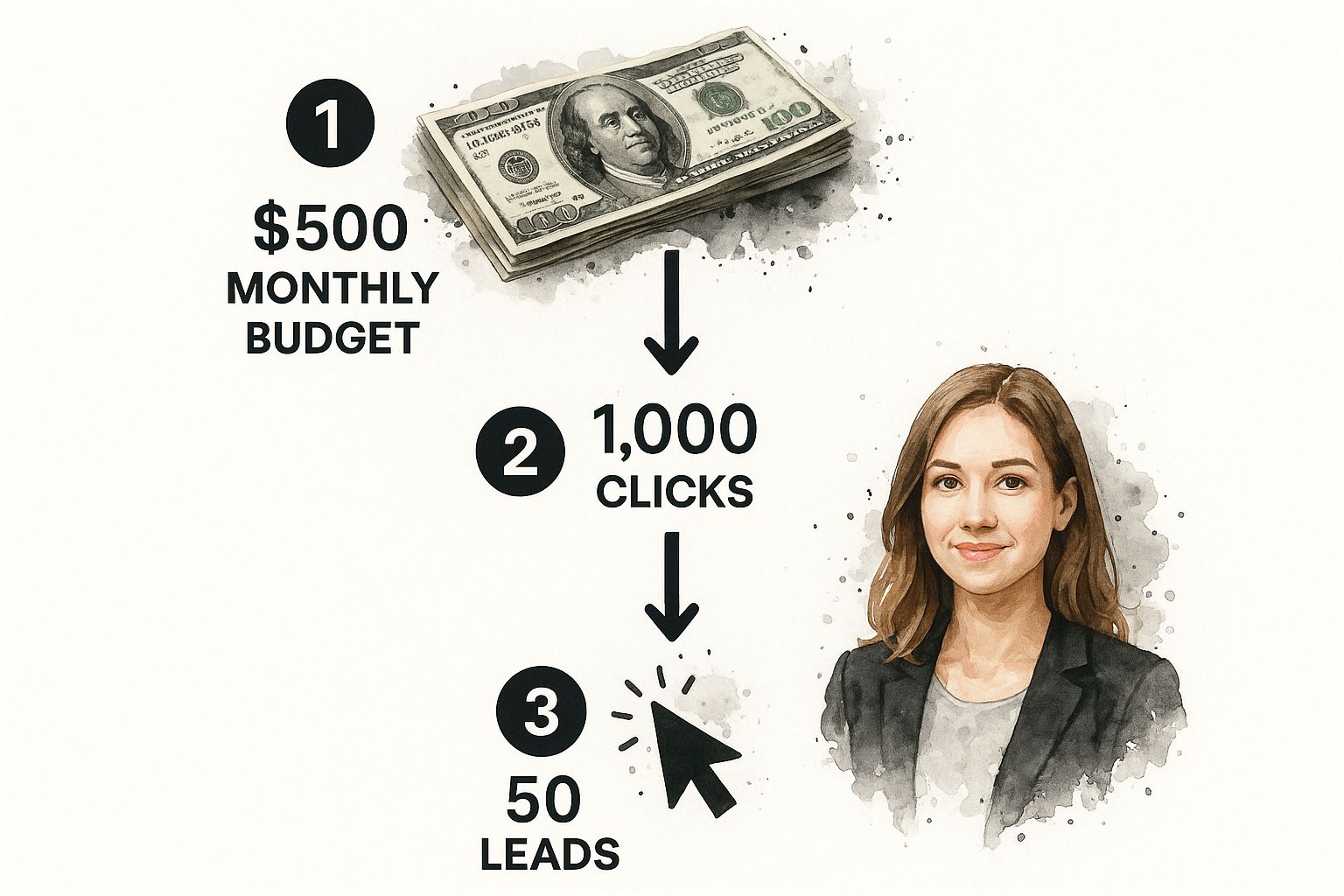
Once those leads are in your ecosystem, your automated system must engage them immediately.
Win the Race with Speed-to-Lead
When it comes to online leads, speed is everything. The first agent to respond is most likely to get the business. When someone fills out a form on your site or a Facebook Lead Ad, they are engaged in that moment. If you wait even 30 minutes to respond, they may have already moved on.
Automation is a game-changer here. Your CRM should be configured to send an instant response the moment a lead comes in.
This first touchpoint should be a one-two punch:
- An immediate text message: SMS has an open rate of over 98%. A text like, "Hi [First Name], this is [Your Name]. I just received your request for information. I'm with a client right now but will call you in about 15 minutes. Is that a good time?" confirms you received their inquiry and sets expectations.
- A follow-up email: The email can offer additional value, such as a link to the listing they viewed or a free homebuyer's guide.
This simple combination puts your name in front of them twice, instantly, and dramatically increases the likelihood of a conversation.
Connect Your Tools for a Hands-Off Workflow
Leads come from various sources—your website, Zillow, Facebook Ads, and open houses. Manually entering each contact into your CRM is inefficient and can lead to lost opportunities.
A tool like Zapier can act as the glue between your lead sources and your CRM, creating a seamless workflow.
For example, you can set up a "zap" that automatically:
- Captures a new lead from a Facebook Lead Ad.
- Pushes that information into your CRM.
- Tags the contact as a "New Facebook Lead" and assigns them to the appropriate follow-up plan.
- Triggers your automated "Welcome" SMS and email sequence.
This all happens instantly, ensuring every lead receives immediate attention and giving you a significant competitive advantage.
Build an Intelligent Nurture Campaign
Most leads are not ready to transact immediately. An automated "drip" campaign is how you stay top-of-mind, building trust over time so that when they are ready, you're the only agent they consider.
The key is to create a campaign that feels helpful, not spammy. A thoughtful mix of valuable content and personal check-ins is far more effective than a rigid, sales-focused sequence.
Sample 8-Week Lead Nurture Sequence
This blueprint blends automated messages with manual tasks to create a natural-feeling follow-up process.
| Week | Touchpoint 1 (Automated) | Touchpoint 2 (Manual/Automated) |
|---|---|---|
| Week 1 | Day 1 SMS/Email: Instant welcome and introduction. | Day 3 Personal Email: "Just checking in. Any initial questions I can answer about the [Neighborhood] market?" |
| Week 2 | Automated Email: Send a link to a blog post: "5 Mistakes to Avoid When Buying a Home in [Your City]." | Manual Task: Schedule a quick phone call to introduce yourself personally. |
| Week 4 | Automated Email: Share a local market update or a neighborhood guide. | Automated SMS: "Hi [First Name], saw this new listing and thought of you. [Link to property]." |
| Week 8 | Automated Email: Offer a free, no-obligation buyer or seller consultation. | Manual Task: Assess engagement and move the lead to a long-term monthly newsletter list if they haven't responded. |
A structured flow like this ensures you consistently provide value, which is the foundation of any good long-term client relationship.
Let Lead Scoring Show You Who's Ready
As your pipeline grows, you can't give every contact the same level of attention. Lead scoring is an automated process within your CRM that assigns points to leads based on their actions, helping you identify the most engaged prospects.
For example, you could set up rules like this:
- Opens an email: +1 point
- Clicks a link in an email: +3 points
- Visits your website's home valuation page: +10 points
- Views a specific listing 3+ times: +15 points
When a lead's score reaches a certain threshold (e.g., 25 points), your CRM can notify you to make a personal phone call. This data-driven strategy ensures you spend your time on the people most likely to convert.
Your Top Real Estate Lead Questions, Answered
As you scale your lead generation efforts, questions are inevitable. Knowing where to invest your time and money is what separates growing agents from those who stagnate. Here are answers to some of the most common questions we hear.
How much should I spend on real estate leads?
While there's no single magic number, a common rule of thumb is to reinvest 10% of your gross commission income (GCI) into marketing and lead generation. So, for a $100,000 GCI, a $10,000 reinvestment is a solid benchmark.
However, the most important metric is your Return on Ad Spend (ROAS). Instead of focusing on a fixed budget, track how much commission each dollar invested generates. This data-driven approach helps you identify what's working and gives you the confidence to scale your budget accordingly.
Are Zillow leads worth it?
Zillow can provide high-intent leads from buyers and sellers who are actively searching. However, these leads are often expensive and sent to multiple agents simultaneously, creating immediate competition.
A more sustainable approach is to generate your own exclusive leads through platforms like Meta or Google Ads. This gives you full control over the client relationship, builds your own brand, and often results in a lower CPL. We recommend testing both channels to see what delivers the best ROI for your specific market.
What is the fastest way to get real estate leads?
If you need leads immediately, paid advertising is the fastest and most predictable method. Organic strategies like SEO are crucial for long-term growth but can take months to gain momentum.
- Google Ads are ideal for capturing high-intent prospects who are actively searching for terms like "realtor near me."
- Meta Ads (Facebook & Instagram) are effective for reaching specific local audiences before they even begin their formal search, creating demand where it didn't exist.
For agents looking to fill their pipeline quickly, a well-executed paid ad campaign is the most direct path to results.
Want to simplify your ad campaigns? Discover our fully managed Meta and Google Ads solutions. Book a free demo with us or send us an email at hello@goadfuel.com for more information.


