

Improving your click-through rate comes down to three things: writing highly relevant ad copy, designing compelling visuals, and offering an irresistible value proposition. Get these pillars right, and you'll not only attract more clicks but also send powerful signals to platforms like Google and Meta, confirming that your ads are a perfect match for your target audience. This guide provides a strategic framework for realtors, local service providers, and marketing managers looking to turn ad views into valuable leads.
Why Your Click-Through Rate is a Big Deal
Before diving into tactics, let's establish a core truth: your click-through rate (CTR) is more than just a performance metric. It’s a direct measure of how well your ad resonates with your target audience. For realtors, local service providers, and small business owners, a high CTR is a clear indicator that your messaging is hitting the mark.
A strong CTR creates a ripple effect that improves your entire campaign's health. It's a critical component of your Quality Score on Google Ads and your relevance scores on platforms like Meta. A higher score almost always translates into tangible benefits for your bottom line.
The Ripple Effect of a Strong CTR
When ad platforms see that users consistently click your ad, they reward you for delivering a positive experience. This initiates a feedback loop with significant advantages:
- Lower Ad Costs: A better CTR often leads to a lower cost-per-click (CPC). Ad platforms prioritize showing ads that users find engaging, so they offer you a discount on premium ad placements.
- Improved Ad Positioning: On Google, a high CTR can help your ad appear higher on the search results page—even if you aren't the highest bidder.
- More Traffic and Leads: It’s simple math. A better CTR drives more qualified traffic to your landing pages, which means more opportunities to capture leads and grow your business.
A high click-through rate is your audience telling you, "Yes, this is exactly what I was looking for." It’s the single most important feedback loop for measuring ad relevance and creative effectiveness.
Let's put this into a real-world scenario. Imagine a realtor in Boca Raton is running two different ads for a luxury waterfront property. One ad achieves a 5% CTR, while the other only manages 1%. The first ad isn't just getting more clicks; it's almost certainly reaching a more qualified audience, resulting in better leads at a more efficient cost.
This is the foundational concept you need to grasp. Once you do, you can stop guessing and start building a strategic framework for growth. Let's break down the core pillars that drive higher click-through rates.
The Three Pillars of High Click-Through Rates
| Pillar | Core Principle | Example for a Realtor |
|---|---|---|
| Relevance | Your ad must directly match the user's intent or interest. It should feel like the perfect answer to their search or a natural fit in their feed. | An ad showing "Luxury Waterfront Homes in Boca Raton" appears when someone searches for exactly that. The copy and images feature stunning ocean views. |
| Visual Appeal | Your creative—whether it's an image or a video—needs to stop the scroll. It has to be eye-catching, high-quality, and emotionally engaging. | Instead of a generic stock photo, the ad uses a professional drone shot of a stunning property at sunset, immediately grabbing attention. |
| Value Proposition | Your ad needs to offer a clear, compelling reason to click now. What makes your offer unique, urgent, or too good to pass up? | The ad copy includes an irresistible offer: "Tour 5 Luxury Homes This Weekend & Receive a Free Pre-Approval Consultation." |
By keeping these three pillars in mind, you’ll have a solid framework for creating ads that don't just get seen—they get clicked.
Crafting Ad Copy That Demands Attention

Think of your ad copy as the first conversation you have with a potential client. It's your digital handshake and value proposition rolled into one. If that message falls flat, even the most stunning visual won't save your campaign.
Writing copy that stops the scroll is part art, part science. It requires getting inside the minds of your ideal customers—understanding their pain points, desires, and motivations. The goal isn't just to describe what you do; it's to start a dialogue they can't ignore.
Write Headlines That Stop the Scroll
Your headline is 80% of the battle. If it doesn't hook the reader immediately, the rest of your ad is practically invisible. The best headlines are laser-focused, communicate a clear benefit, and often create curiosity or urgency.
Here are a few proven formulas to boost click-through rates:
- Ask a Question: A direct question engages the reader’s mind. For a home services business, "Tired of Your Outdated Kitchen?" is far more compelling than "Kitchen Remodeling Services."
- State a Clear Benefit: Tell them exactly what's in it for them. A realtor could use, "Sell Your Home Faster & For a Higher Price," because it directly addresses what every seller wants.
- Create Urgency or Scarcity: Phrases like "Limited-Time Offer" or "Only 3 Spots Left" trigger a fear of missing out and prompt immediate action.
- Use Numbers and Data: Numbers feel concrete and add credibility. "Join 150+ Happy Homeowners in Austin" provides social proof that a generic statement cannot match.
Speak Directly to Your Audience’s Pain Points
The most powerful ad copy doesn’t sell a service; it sells a solution. Before writing, you must understand what keeps your audience up at night. What are their biggest frustrations or unanswered questions? Once you know, address them directly in your ad's body text.
Great ad copy acts like a mirror, reflecting the customer's problem back at them before presenting your service as the clear solution. This approach builds an immediate sense of understanding and trust.
Take a local plumber in Miami, for example. They shouldn't just say, "We Fix Leaks." A much stronger approach would tap into a homeowner's stress: "A burst pipe can cause thousands in damage. Get a certified plumber to your Miami home in under 60 minutes—day or night." This copy zeroes in on the pain (expensive damage) and offers a fast, credible solution.
Leverage Psychological Triggers
Beyond addressing pain points, you can weave in proven psychological principles to make your copy more persuasive. These are effective ways to frame your message to align with how people naturally think and act.
Here are three reliable triggers:
- Social Proof: People trust what others are doing. Mentioning customer numbers, quoting reviews, or referencing testimonials builds instant credibility. A financial advisor might use, "Trusted by over 200 families in Tampa to secure their financial future."
- Urgency: Creating a reason to act now is one of the most effective ways to improve click-through rates. Use time-sensitive language like "Offer ends Friday," "Last chance," or "Book your free estimate this week only."
- Specificity: Vague promises are forgettable; specific details are believable. Instead of "Fast Service," try "Same-Day Roof Repair Estimates Guaranteed." The difference is clear.
When you master these techniques, your ads aren’t just seen—they're felt. A great next step is to combine multiple copy variations with different images and headlines using tools for dynamic creative optimization, which allows platforms like Meta to automatically discover the winning combinations for you.
Create a Clear and Irresistible Call to Action
Finally, every ad needs a powerful Call to Action (CTA). Your CTA isn’t just a button; it’s the final instruction that tells the user exactly what to do next. A weak or confusing CTA will kill your CTR, even if the rest of your ad is brilliant.
Ditch the generic "Click Here." Instead, make your CTAs specific, action-oriented, and focused on the value the user receives.
- For a Real Estate Agent: "Get Your Free Home Valuation"
- For a Local Plumber: "Request an Emergency Quote"
- For an E-commerce Store: "Shop the Fall Collection Now"
Your CTA should feel like the natural conclusion to the story your ad tells, delivering on the promise of your headline and guiding the user toward becoming a lead or customer.
Designing Visuals That Drive Clicks

If your copy is the engine of your ad, the visual is the polished exterior that captures attention. In a fast-moving feed, you have less than a second to make an impression. A compelling visual isn’t just decoration; it’s what stops the scroll and generates that crucial first flicker of interest.
Getting your visuals right is a blend of art and science. It’s about understanding which colors pop, what compositions draw the eye, and what your audience wants to see on a specific platform. An image that performs well on the Google Display Network may not work in an Instagram Story.
This is more important than ever. According to the latest Google Ads benchmarks on Wordstream, strong visuals are a key driver of rising CTRs across many industries. As ads become more integrated with organic content, compelling creative is no longer optional.
High-Quality vs. Authentic Content
A common debate in creative strategy is "polished vs. real." Should you use slick, professional imagery or opt for something that feels more like user-generated content (UGC)? The answer depends on your brand, audience, and campaign goals.
- High-Quality, Professional Imagery: Think crisp product shots, perfectly staged real estate photos, or sleek brand graphics. This style conveys authority and quality, building trust. For a realtor selling a luxury home, professional photos are non-negotiable—they justify the premium price tag.
- Authentic, User-Generated-Style Content: This content feels real, relatable, and less "salesy." It could be a smartphone video from a happy customer or a behind-the-scenes shot of your team. This approach builds a genuine connection and often outperforms polished ads because it feels more trustworthy.
Imagine a home improvement company in Boca Raton running an A/B test. Ad A is a professional photo of a stunning, finished kitchen. Ad B is a phone video of the homeowner seeing it for the first time, overjoyed. Which one do you think would get more clicks? My money is on the authentic reaction every time.
Key Visual Elements That Boost Clicks
You don’t have to reinvent the wheel to lift your CTR. Focus on testing and optimizing a few core visual elements that consistently drive results.
Human Faces and Emotion
We are hardwired to connect with other people. Including a smiling, relatable face in your ad can make your brand feel more human and approachable. The emotion you display—whether it’s excitement, relief, or confidence—helps your audience feel the positive outcome your service delivers.
Color and Contrast
Your ad needs to stand out. Use contrasting colors to draw the viewer's eye toward your main subject and, most importantly, your call-to-action button. A basic understanding of color psychology can help—blue often conveys trust, while orange can create urgency.
Video vs. Static Images
Short-form video dominates social feeds for a reason: movement grabs attention. Even a simple animated graphic or a 5-10 second video clip can outperform a static image. Test short videos that tell a quick story or show your product in action. A local painter could use a time-lapse of a room transformation to showcase their speed and quality.
Optimizing Creatives for Different Platforms
Finally, remember that one size never fits all. The visual that works wonders in a Facebook feed will look out of place in an Instagram Story or on Google’s Display Network.
Always create assets that are natively sized for each placement. It looks more professional, fills the screen correctly, and ensures your message isn't awkwardly cropped. Check out our guide to the most effective ad sizes and dimensions to get it right every time.
How to Improve Click Through Rates with Audience Targeting
You can have brilliant copy and stunning ad creative, but if you show it to the wrong people, it will fail. Mastering audience targeting is your single greatest advantage. When you deliver a hyper-relevant message to a hyper-relevant audience, a higher click-through rate is the natural result.
The key is moving beyond the obvious. Modern ad platforms offer powerful tools to pinpoint users who are actively signaling their readiness to buy. This is how to improve click through rates in a sustainable, data-driven way.
Moving Beyond Basic Demographics
Knowing your customer's age and location is a starting point, but true performance gains come from digging into psychographics, online behaviors, and intent signals.
Think about a realtor in Austin. Instead of only targeting users aged 30-55 in the Austin area, they could target users Google has identified as being "in-market for a new home." This simple shift focuses ad spend exclusively on people looking to move, dramatically increasing relevance.
The core principle of advanced targeting is simple: stop interrupting people who don't care, and start engaging people who are already looking for you. This transition from interruption to engagement is the fastest path to a higher CTR.
Advanced Targeting Strategies That Actually Work
To make your ad spend more efficient, lean into the sophisticated audience-building tools on platforms like Meta and Google. These strategies help you zero in on the most qualified users.
- Lookalike Audiences: This is one of the most powerful tools available. You upload a list of your best customers, and the platform’s algorithm finds new users with similar characteristics and online behaviors.
- Custom Intent Audiences: On Google, you can build audiences based on keywords people have recently searched for. A local plumber could target users who just searched "emergency plumbing services," ensuring their ad appears at the exact moment of need.
- Retargeting Website Visitors: Don't let warm leads go cold. Create an audience of everyone who has visited your website (or specific pages) in the last 30-90 days. Showing these users a follow-up ad is a simple way to stay top-of-mind.
For businesses with a physical location, geographic targeting is essential. With geofencing, you can draw a virtual perimeter around specific neighborhoods or even your competitors' locations. For a deeper dive, explore our guide to location-based advertising.
Targeting Strategy Comparison
Choosing the right targeting strategy depends on your campaign goals. Some methods are ideal for finding new customers, while others are designed to re-engage people who already know you.
| Targeting Method | Best For | Platform Example |
|---|---|---|
| Lookalike Audiences | Finding new, high-quality prospects who share traits with your existing customers. | Meta Ads |
| Custom Intent Audiences | Reaching people who are actively researching products or services you offer right now. | Google Ads |
| Website Retargeting | Re-engaging users who have already shown interest in your brand by visiting your site. | Google Ads, Meta Ads |
The best campaigns often layer these strategies, creating a full-funnel approach that captures users at different stages of their buying journey.
Real-World Targeting Scenarios
Let's see how this works in practice.
- A Realtor's First-Time Homebuyer Campaign: A real estate agent in Boca Raton wants to connect with first-time homebuyers. She builds a custom audience on Facebook targeting users interested in Zillow, mortgage calculators, and local moving companies. She then layers this with a lookalike audience built from her list of past first-time buyer clients.
- A Roofer's Geo-Targeted Push: A roofing company operates in a storm-prone area. After a hail storm hits a specific subdivision, they use zip code targeting on Google Ads for keywords like "hail damage roof repair," ensuring their message is seen by those who need them most.
Common Targeting Mistakes to Avoid
Getting targeting wrong is a fast way to burn through your budget. Avoid these common pitfalls:
- Going Too Broad: Targeting an entire country without adding other layers is a recipe for low relevance and wasted spend.
- Going Too Narrow: Creating an audience so small (e.g., under 1,000 people) that the platform can't properly optimize delivery is also problematic.
- Forgetting to Exclude Audiences: Always exclude existing customers from new customer acquisition campaigns to avoid wasting money and showing irrelevant offers to loyal clients.
- Setting It and Forgetting It: Audiences become fatigued over time. Monitor performance and be ready to test new audiences to keep results from going stale.
Optimizing Your Landing Page to Fulfill the Promise

Congratulations, you got the click. But that’s only half the battle. A high click-through rate means nothing if users land on your page and immediately leave. Your ad makes a promise, and your landing page is where you deliver on it.
A clunky, slow, or confusing landing page will destroy your conversion rates, making your ad spend feel wasted. To turn that click into a customer, you must create a seamless journey from the ad to the thank you page.
Nail the Message Match
The golden rule of landing page optimization is message match. The headline, images, and offer on your page must mirror the ad that brought the user there. Any disconnect, no matter how small, creates friction and erodes trust.
If a user clicks an ad for "50% Off Emergency Plumbing Services," they need to see that exact phrase—big and bold—the moment the page loads. You have seconds to reassure them they’ve come to the right place. Perfect alignment validates their click and gives them a reason to stay.
Design for Thumbs, Not Cursors
Today, optimizing for mobile is non-negotiable. The vast majority of social and search traffic comes from a phone. A page that looks great on a desktop but is a nightmare on mobile is actively losing leads.
- Speed is Everything: Your page needs to load in under three seconds.
- Thumb-Friendly Design: Buttons and form fields must be large enough to tap easily.
- Keep It Simple: A clean, single-column layout with plenty of white space makes your content easy to scan on a small screen.
A slow or poorly designed mobile experience is one of the fastest ways to lose a potential lead. We have seen clients boost conversions simply by shaving one second off their load time. It's that critical.
Build Instant Credibility
When someone lands on your site for the first time, you are a stranger. You have about five seconds to convince them you're legitimate. This is where social proof becomes your most powerful asset.
Strategically place these trust signals across your landing page:
- Customer Testimonials: Short, powerful quotes from happy clients.
- Review Ratings: Star ratings from Google, Yelp, or industry-specific sites.
- Trust Badges: Logos from the Better Business Bureau or security providers.
- Clear Contact Info: A visible phone number and address show you're a real business.
By optimizing your landing page, you fulfill the promise your ad made. This creates a positive experience that guides users smoothly toward becoming your next paying customer.
Using Analytics and Testing to Fuel Continuous Growth
Great ad copy, stunning visuals, and perfect targeting will get you in the game, but they won't win it for you. The difference between a good campaign and a great one comes down to what happens after you launch. This is where you shift from educated guesswork to building a predictable, data-driven growth engine.
Adopting the Continuous Improvement Loop
The secret to sustainable growth is a simple, repeatable framework: Analyze, Hypothesize, Test, and Implement. Think of it as a flywheel that builds momentum and keeps your campaigns from going stale.
- Analyze: Dive into your campaign data. Look for ads with high impressions but below-average CTR. Do ads with human faces outperform product shots?
- Hypothesize: Form a clear, testable hypothesis. For example: "Changing my generic 'Learn More' CTA to a benefit-focused 'Get Your Free Home Valuation' will increase CTR because it offers tangible value."
- Test: Run a clean A/B test. Create a new ad variation that is identical to your control ad except for the one element you're testing.
- Implement: Let the test run until you have statistically significant data. Once you have a clear winner, pause the loser and make the improved element your new control. Then, start the cycle again.
This straightforward process is the core skill behind learning how to improve click through rates month after month.
Setting Up Meaningful A/B Tests
Effective A/B testing requires focus. The biggest mistake advertisers make is testing too many variables at once. If you change the headline, image, and CTA, you’ll have no idea which change moved the needle.
Instead, isolate one variable at a time. Here are high-impact elements perfect for testing:
- Headlines: Pit a question-based headline against one that leads with a strong benefit.
- Images: Test a polished stock photo against an authentic, user-generated style image.
- CTAs: Compare a low-commitment CTA ("See Details") with a high-value one ("Download Your Free Guide").
- Ad Copy: Test short, punchy copy against a longer, more detailed version.
A disciplined A/B testing strategy is your campaign’s compass. It removes subjectivity and points you directly toward the creative and messaging that your audience truly prefers, turning small wins into significant, long-term performance gains.
Looking Beyond CTR for the Full Picture
While a high CTR is a fantastic sign, it’s not the whole story. To understand how your campaigns are performing, you have to look at what happens after the click.
Here are other KPIs to watch:
- Conversion Rate: What percentage of people who clicked the ad took the desired action on your landing page? A high CTR with a low conversion rate often means a disconnect between your ad and landing page.
- Cost Per Acquisition (CPA): How much are you paying for one new lead or customer? A campaign can have a great CTR, but if the CPA is too high, it isn't profitable.
- Bounce Rate: How many people click your ad and immediately leave your landing page? A high bounce rate is a red flag that your page may be slow, confusing, or irrelevant.
Mobile performance is especially important here. Small tweaks to the mobile experience can deliver massive results.
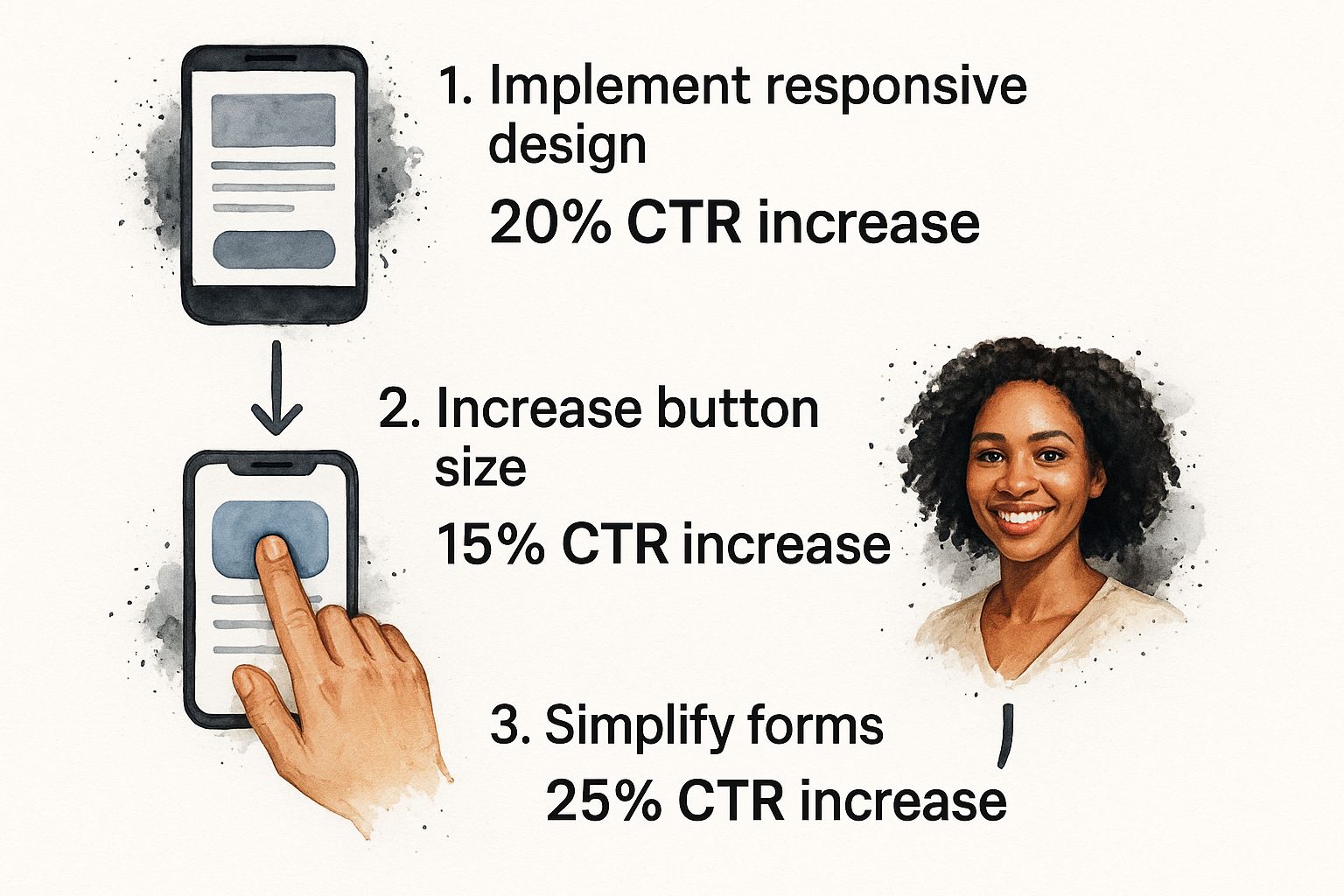
Performance also varies significantly by industry. According to industry CTR findings from Advanced Web Ranking, CTRs can differ wildly from one sector to another, highlighting why you must test what works for your specific audience. By embracing a culture of continuous testing and looking at the full picture of performance metrics, you create a powerful engine for growth that drives tangible results.
Key Takeaways and Next Steps
Improving your click-through rates is an ongoing process of refinement, not a one-time fix. To recap, focus on these key pillars:
- Craft Compelling Copy: Write clear, benefit-driven headlines and speak directly to your audience's pain points.
- Design Stop-Scrolling Visuals: Use high-quality, authentic images or video that grab attention and align with your brand.
- Master Audience Targeting: Move beyond basic demographics to reach users who are actively looking for your solution.
- Optimize the Post-Click Experience: Ensure your landing page fulfills the promise made in your ad with perfect message match and a seamless mobile experience.
- Test and Analyze Continuously: Adopt an A/B testing mindset to consistently learn what resonates with your audience and improve performance over time.
By focusing on these strategies, you'll not only increase your CTR but also drive more qualified traffic, generate higher-quality leads, and achieve a better return on your ad spend.
Want to simplify your ad campaigns? Discover our fully managed Meta and Google Ads solutions. Book a free demo with us or send us an email at hello@goadfuel.com for more information.


