

You can't just "set and forget" a PPC campaign and expect results. To effectively manage PPC campaigns, you need a continuous cycle of smart planning, careful execution, and constant monitoring. It's this disciplined approach that ensures your ad spend actually turns into tangible business growth—like leads for your real estate brokerage or sales for your e-commerce store—instead of just vanishing into the digital ether.
This guide provides a professional playbook to stop wasteful spending and start implementing the strategies that drive real, measurable outcomes.
The Modern Playbook for PPC Campaign Management

ALT Text: A professional managing a PPC campaign on a laptop, with charts and graphs in the background.
Let’s be honest: launching a pay-per-click (PPC) campaign is easy. But managing one for consistent, predictable profit? That’s where the real work begins. Many businesses dive in with high hopes, only to watch their budget evaporate with little to show for it. This guide is your playbook to stop the aimless spending and start driving real results.
When managed correctly, PPC is a powerhouse. In fact, traffic from PPC ads converts 50% higher than organic traffic, which drives home why a well-oiled campaign is so critical. For a deeper dive, check out these detailed PPC statistics on cropink.com. This guide walks you through the entire campaign lifecycle, giving you actionable steps with a results-focused mindset.
What to Expect from This Guide
We're going to break down the process into key stages that build on one another. You’ll learn the practical, hands-on methods needed to transform your PPC efforts from a budget line item into a core driver of your business.
Our focus is on real-world application, whether you are:
- A realtor in Austin trying to generate high-quality seller leads.
- A local home service provider in Boca Raton who needs to book more appointments.
- A national e-commerce brand driving direct product sales online.
Key Takeaway: The difference between a thriving PPC account and a failing one isn't the platform—it's the management. A structured, data-informed process is non-negotiable for achieving a positive return on ad spend.
This playbook is designed to give you that structure. We’ll start by building a rock-solid foundation, move to flawless execution, and finish with the ongoing optimization that creates long-term success.
Essential KPIs for PPC Campaign Management
Before we dive into the "how," it's crucial to know what to measure. The right Key Performance Indicators (KPIs) tell you if your campaign is working at every stage of the customer journey. Without tracking the right metrics, you're flying blind.
Here’s a breakdown of the essential KPIs you should be watching:
| Funnel Stage | Primary KPI | Supporting Metrics | Business Goal |
|---|---|---|---|
| Top of Funnel (Awareness) | Impressions / Reach | Clicks, Click-Through Rate (CTR) | Introduce your brand to a broad, relevant audience. |
| Middle of Funnel (Consideration) | Click-Through Rate (CTR) | Cost Per Click (CPC), Landing Page Views | Drive qualified traffic and gauge user interest. |
| Bottom of Funnel (Conversion) | Conversion Rate | Cost Per Acquisition (CPA), Return on Ad Spend (ROAS) | Turn interested users into leads or customers. |
| Post-Funnel (Loyalty) | Customer Lifetime Value (CLV) | Repeat Purchase Rate, Engagement Rate | Foster repeat business and build long-term value. |
These metrics are the language of your campaign's performance. Understanding what they mean and how they relate is fundamental to making smart, profitable decisions.
Building Your Strategic Foundation Before You Spend
Before you spend a single dollar, let's talk about what actually makes a campaign successful. I've seen it a hundred times: businesses diving headfirst into Google Ads without a blueprint, only to pour money down the drain. It's chaotic, expensive, and rarely works.
The real wins are secured long before your first ad goes live. This is where you lay the essential groundwork for a profitable, scalable campaign. It all starts with defining your business objectives. What does a "win" actually look like for you? Are you an e-commerce store chasing direct sales? Or a real estate brokerage focused on generating high-intent seller leads? Your core goal dictates every decision from here on out.
Define Your Ideal Customer
Once you know what you want to achieve, you have to figure out who you're talking to. Vague assumptions about your audience lead to generic ads that get ignored. The goal is to build detailed customer personas that feel like real people with real problems.
A great persona goes beyond basic demographics. You need to get inside their head:
- Pain Points: What problems keep your ideal customer up at night? For a realtor's client, it might be the stress of timing a home sale with a new purchase.
- Motivations: What are their ultimate goals? A small business owner might be driven by the desire for financial freedom and more time with family.
- Online Behavior: Where do they hang out online? Are they scrolling Facebook, actively searching on Google, or browsing professional networks like LinkedIn?
- Language: What specific words and phrases do they use to describe their needs? This is gold for writing ad copy that connects.
Let's make this real. A local roofer in Boca Raton targeting storm damage won't just aim at "homeowners." They'll build a persona for "John," a 45-year-old father who just sat through a hurricane and is now frantically searching "emergency roof repair Boca Raton" on his phone. That level of detail ensures your ads speak directly to the right person at the exact moment they need you.
Conduct In-Depth Keyword and Competitive Research
With a crystal-clear persona, you can now dig into keyword research. Your mission is to uncover the specific, high-intent phrases your ideal customers are typing into search engines. The real magic is in the long-tail keywords—those longer phrases that reveal exactly what the user wants.
A smart digital marketing strategy integrates paid ads with organic visibility. That's why a solid grasp of search engine optimization (SEO) is so valuable; it helps you understand search intent on a much deeper level.
Pro Tip: Spy on your competitors. A simple Google search for your target keywords will show you who's showing up. What keywords are they bidding on? What does their ad copy look like? This isn't about copying; it's about understanding the landscape.
This foundational work sets the stage for a realistic budget and Return on Ad Spend (ROAS) targets. And make no mistake, the competition is fierce. While businesses earn an average of $2 for every $1 spent on Google Ads, that return is only possible with a sound, well-researched strategy. You can discover more about these compelling PPC statistics and what they mean for your campaigns.
Nailing the Campaign Setup and Launch

ALT Text: A dashboard showing the setup process for a PPC campaign on a computer screen.
With a solid strategy, it's time to bring the campaign to life. This is the technical part where small details can mean the difference between profit and loss. A sloppy setup is a one-way ticket to wasted ad spend, so let's walk through how to execute this with precision on platforms like Google and Meta.
It all starts with a logical and scalable account structure. Think of this as the digital filing cabinet for your ads. Getting this right not only makes it easier to manage PPC campaigns but also directly impacts performance by making your ads hyper-relevant.
For instance, a real estate agency shouldn't dump all its services into one massive campaign. A smarter approach is to create separate campaigns for distinct goals, like 'Lead Generation' versus 'Brand Awareness'.
Structuring for Clarity and Control
Within each campaign, you’ll create ad groups. These should be tightly themed around a small, specific cluster of similar keywords. This focus is what platforms like Google reward with a higher Quality Score, leading to lower costs and better ad positions.
Let's stick with our realtor's 'Lead Generation' campaign. A practical ad group structure might look like this:
-
Ad Group 1: Buyer Leads
- Keywords: "homes for sale in [city]," "realtor for first-time buyers," "buy a house in [neighborhood]"
- Ad Copy: The language should speak directly to the dreams and anxieties of homebuyers.
-
Ad Group 2: Seller Valuations
- Keywords: "what is my home worth," "get a free home valuation," "listing agent in [city]"
- Ad Copy: This copy needs to focus on the value of an accurate home estimate and a trustworthy agent.
This segmented approach ensures that when someone searches for home valuation services, they see an ad specifically about that service. This alignment drives higher click-through rates (CTR) and, most importantly, better-qualified leads.
Crafting High-Impact Ads and Landing Pages
With your structure in place, the next piece is writing ad copy that gets clicked. Your ad is the first handshake with a potential customer. It needs to be persuasive, clear, and have a strong call-to-action (CTA). Think "Get Your Free Quote" or "Schedule a Showing."
But a great ad is only half the journey. The experience must be seamless from click to conversion. This means your landing page must continue the conversation your ad started.
A high-converting landing page is not your website's homepage. It’s a dedicated page with one goal: to get the visitor to convert. It must echo the ad's message, be stripped of distractions, and make it ridiculously easy for the user to take action.
The Absolute Non-Negotiable: Conversion Tracking
Finally, before you even think about hitting "launch," you must install conversion tracking. This is completely non-negotiable.
Without it, you are flying blind. You have no way of knowing which keywords, ads, or campaigns are actually making you money. Proper tracking lets you measure your true cost per acquisition (CPA) and return on ad spend (ROAS)—the two metrics that truly matter for profitability. Getting this right from day one is critical for long-term success.
Mastering Ongoing Optimization And Analysis
Launching your PPC campaigns is just the starting line. The real work—and profit—comes from the day-to-day discipline of monitoring, analyzing, and tweaking your campaigns to squeeze every drop of value from your ad spend. This is where you turn a good campaign into a great one by letting the data guide your every move.
Establishing A Practical Review Routine
To stay on top of your campaigns without getting overwhelmed, you need a rhythm. Trying to check every metric every day leads to burnout and poor decisions. Instead, break down your analysis into a manageable schedule.
Here’s a simple framework that works:
- Daily Checks (5-10 Minutes): This is your quick health check. Are campaigns running? Is spending within budget? Look for big red flags, like a sudden spike in cost-per-click (CPC) or a campaign that has stopped getting impressions.
- Weekly Analysis (30-60 Minutes): This is your main optimization session. Dive into the last seven days of performance. Pinpoint your best and worst-performing ad groups, keywords, and ads. This is where you’ll make most of your tactical adjustments.
- Monthly Review (1-2 Hours): Zoom out and look at the bigger picture. Analyze performance trends over the past 30 days. Are you hitting your overall return on ad spend (ROAS) goals? This is when you make larger strategic calls, like shifting budget or planning new tests.
This structured approach keeps you focused on actions that actually move the needle.
Core Optimization Techniques
Once you've got a routine, you can get down to the nitty-gritty of optimization. These are the levers you'll pull to consistently improve performance.
Refining Your Keywords
Your keyword list is a living thing. A keyword with a fantastic click-through rate (CTR) but zero conversions is a massive red flag. When this happens, play detective. Is the searcher's intent different from what you assumed? Is your ad making a promise your landing page fails to deliver?
The solution is relentless refinement. Don't be afraid to pause underperforming keywords. More importantly, build a robust negative keyword list. This tells Google what searches you don’t want your ads to show up for, stopping you from wasting money on irrelevant clicks. For example, a realtor selling luxury homes would add terms like “cheap,” “foreclosure,” and “for rent” to their negative list.
A/B Testing And Bid Management
Never assume your first ad is your best ad. A/B testing—running two or more ad variations against each other—is essential. You should constantly test different headlines, descriptions, and calls-to-action to find more effective messaging.
Bid management is another critical piece. You can adjust bids manually for maximum control, or you can lean on automated strategies. For larger campaigns, automated bidding can be a game-changer.
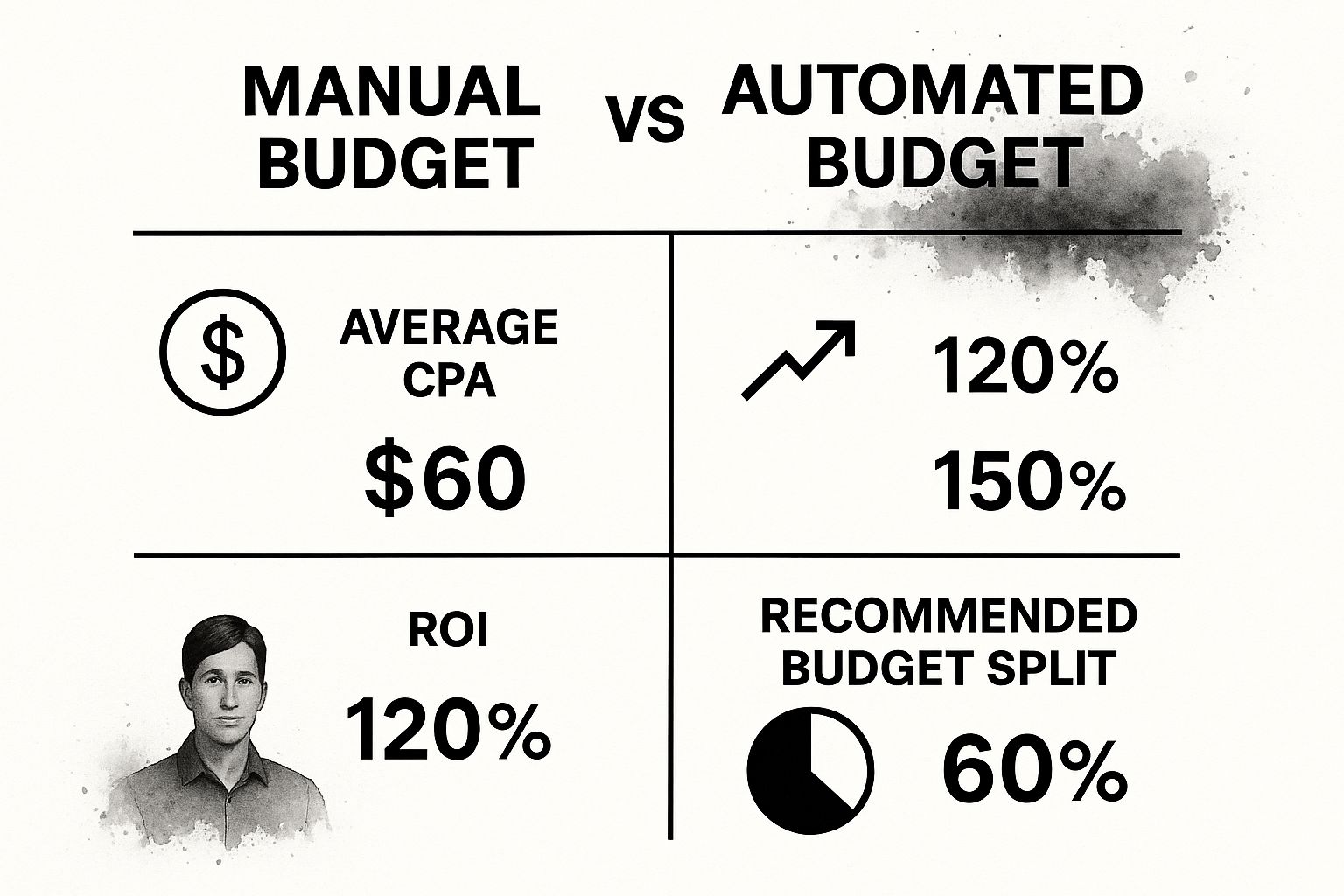
ALT Text: A chart comparing the lower CPA and higher ROI from an automated bidding strategy versus manual bidding.
As you can see, automated bidding often leads to a lower Cost Per Acquisition (CPA) and a higher ROI. It uses machine learning to set the perfect bid for every auction, a task that’s impossible to do manually at scale.
Troubleshooting Common Campaign Headaches
Even with a solid routine, things can go wrong. The key is knowing how to diagnose the problem quickly and what levers to pull to fix it. This table covers some of the most frequent problems and how to troubleshoot them.
Common PPC Problems and How to Fix Them
| Common Problem | Potential Cause | Actionable Solution |
|---|---|---|
| High Clicks, No Conversions | – Mismatch between ad copy and landing page – Poor landing page experience (slow, confusing) – Keyword intent is informational, not transactional |
– Audit your landing page for clarity and a strong CTA – Improve page speed and mobile usability – Add negative keywords to filter out research-only terms |
| Low Click-Through Rate (CTR) | – Irrelevant or boring ad copy – Bidding too low to get a good ad position – Targeting the wrong audience |
– A/B test new headlines and descriptions – Use ad extensions to take up more space – Increase bids on high-performing keywords |
| Campaign Budget Spent Too Quickly | – Bids are too high – Targeting is too broad – Click fraud or irrelevant clicks |
– Lower your bids or switch to a CPA-focused bid strategy – Refine audience targeting (location, demographics) – Build a comprehensive negative keyword list |
| Sudden Drop in Impressions | – Ad disapproval or policy violation – Low bids or budget exhaustion – Increased competition in the auction |
– Check your email and ad platform for policy alerts – Review daily budget and keyword bids – Use Auction Insights to see what competitors are doing |
Think of this table as your first-aid kit for PPC. When you spot one of these issues, don't panic. Work through the potential causes and test the solutions methodically.
Scaling with Advanced Strategies and New Platforms
ALT Text: A person looking at a multi-channel PPC dashboard showing performance across Google, Meta, and LinkedIn.
Once your campaigns are humming along and hitting their targets, it’s time to shift from optimization to strategic scaling. This is where you go beyond the fundamentals to find new pockets of growth and pour fuel on the fire.
A huge part of this is getting smart about automation. Tools like Google's Performance Max can hunt down conversions across Google’s entire ecosystem. But success isn't about just handing over the keys. The magic happens with a hybrid approach: you provide the strong strategic direction (high-quality creative, sharp audience signals), and you let machine learning handle the micro-optimizations. This shifts your role from a day-trader managing bids to a portfolio manager guiding the overall strategy.
Diversifying Your Platforms for Broader Reach
Relying only on Google Search is like fishing in just one corner of a massive lake. To scale, you have to diversify your ad platforms and meet customers where they are. This isn't about spreading your budget thin; it's about making calculated moves into new channels based on where your audience spends its time.
Consider these expansion opportunities:
- Meta Ads (Facebook & Instagram): This is your go-to for building audiences based on their interests and behaviors. A real estate agent, for instance, could use Meta Ads to run a brand awareness campaign in a specific zip code or retarget website visitors.
- LinkedIn Ads: If you're in the B2B space, this is non-negotiable. It’s the only place you can target users by job title, company size, and specific industry with such precision.
- Google Display Network: This is your engine for powerful remarketing. By showing visual ads to people who have already visited your site, you stay top-of-mind and nudge them back to convert.
Today's PPC world is being reshaped by AI. With Google's dominance in search ads potentially seeing a dip, savvy advertisers are allocating 10–15% of their budgets to test emerging channels like TikTok. To get a better handle on this shift, you can explore the latest PPC statistics and trends.
A Framework for Testing New Channels
When you’re ready to dip your toes into a new platform, the worst thing you can do is go all-in. You need a structured testing framework.
Carve out a small, experimental slice of your budget—say, 5-10%—and set clear goals for a 30- to 60-day test run.
The initial goal isn't immediate profitability. It's data collection. Is this audience responsive? What’s the cost per click? Can we generate initial interest? This data gives you what you need to make an informed decision: scale up your investment or pull the plug and move on. This measured approach lets you stay ahead of the curve without putting your core campaign performance at risk.
Common Questions We Get About Managing PPC Campaigns
When you first jump into paid advertising, it’s normal to have questions. As you start to manage your own PPC campaigns, you're bound to run into challenges. Here are some of the most frequent questions we hear from business owners and marketers.
How Much Should I Spend on PPC When I'm Just Starting Out?
There’s no magic number, but there is a smart way to approach it. Instead of pulling a number out of thin air, first figure out what a new lead or sale is worth to your business. This gives you a powerful starting point for your budget.
For most local service businesses, a starting budget between $500 and $2,000 per month is a great place to begin. It's enough to gather meaningful data without a huge upfront investment. Think of that first month's budget as tuition. Focus it on a few high-intent campaigns. Once you see what's working, then you can scale up with confidence.
How Long Until I See Real Results from a New Campaign?
While you can get clicks almost instantly, seeing meaningful business results—like a steady stream of qualified leads—takes time. It's important to set realistic expectations.
Plan for a "data collection" phase of at least 30 to 90 days. During this time, the ad platform’s algorithms are learning, and you’re gathering the critical performance data needed to start optimizing effectively.
This is the period where you'll build out negative keyword lists, test ad copy, and fine-tune your targeting. Sustainable, long-term ROI is built on this foundation of continuous improvement. Patience and a data-first mindset are your best friends.
What's a Good Quality Score and How Do I Improve It?
In Google Ads, a Quality Score of 7 out of 10 or higher is what you should be aiming for. It’s Google’s report card on your ad's quality and relevance, and it directly impacts your ad position and cost per click.
Improving it boils down to three key things:
- Ad Relevance: Make sure your ad copy mirrors the keywords in your ad group.
- Expected Click-Through Rate (CTR): Write compelling, interesting ads that make people want to click.
- Landing Page Experience: Your landing page must continue the conversation your ad started. It needs to be relevant, easy to use, and offer a clear next step.
If you focus on getting these three components right, you'll be on the most direct path to boosting your Quality Score and your entire campaign's performance.
Want to simplify your ad campaigns? Discover our fully managed Meta and Google Ads solutions. Book a free demo with us today or send us an email at hello@goadfuel.com for more information.


