

If you’re running a dental practice, you’ve probably heard the term PPC thrown around. In simple terms, it stands for pay-per-click advertising—a model where you pay a small fee only when someone clicks on your ad.
For a dental practice, PPC is the most direct way to get your name at the top of Google the moment a potential patient is searching for exactly what you offer—whether it's an emergency root canal or a consultation for cosmetic veneers. It’s not just advertising; it’s a direct line to patient intent.
Why Your Practice Needs a PPC Strategy for Dentists
Let's be honest: relying solely on referrals and word-of-mouth is an unpredictable way to grow in today's digital market. While building your website's SEO is crucial for long-term organic growth, it can take months, sometimes even years, to rank for the most valuable patient-generating keywords.
PPC for dentists is the strategic bridge over that gap. It provides immediate access to a consistent stream of high-intent patient leads. This isn't just a marketing expense; it's a direct investment in the predictable growth of your appointment book.
Consider the mindset of someone searching for "emergency dentist near me" or "Invisalign cost in [Your City]." They have an urgent need or a high-value service in mind, and they aren't just browsing. A well-executed PPC campaign ensures your practice is the very first solution they see.

The Core Benefits of Dental PPC
A smart PPC strategy is about much more than website clicks. It’s about delivering real, measurable results that directly impact your practice's bottom line. You get to bypass the slow climb of organic search rankings and connect with patients at the precise moment they’re ready to take action.
This puts you miles ahead of competitors who are still waiting for their SEO efforts to bear fruit. You're essentially buying a front-row seat for the searches that matter most.
Here’s what that looks like in practice:
- Instant Visibility: We can launch a campaign and have your ads showing up on the first page of Google within hours. You’re immediately in front of people actively looking for a dentist.
- Hyper-Targeted Reach: We can target potential patients based on their zip code, the exact keywords they type into Google, their age, and more. This means your budget is spent only on people who are actually likely to become patients.
- Measurable ROI: Unlike a billboard or a radio spot, every click, call, and appointment form submitted from your PPC ads can be tracked. You know exactly what you’re getting for every dollar you invest.
- Total Budget Control: You are always in the driver's seat. Whether you want to start with a small test budget or invest several thousand a month, you set the parameters and can adjust them at any time.
A common mistake is thinking PPC is just about buying traffic. It’s not. A successful campaign is about buying the right traffic—the people in your area who are most likely to become new, loyal patients for your practice.
For a closer look at how PPC fits into a full-funnel growth plan, check out Adfuel's specialized dental marketing services.
Laying the Groundwork for a Winning Dental PPC Campaign
A successful PPC campaign doesn't just happen. It's built on a solid foundation long before the first ad is launched. Getting this initial strategy right is the difference between a predictable stream of new patients and an expensive campaign that burns through your marketing budget with little to show for it.
It all starts with getting crystal clear on what you want to achieve and who you need to reach.
Forget vague goals like "get more patients." A powerful, actionable objective is specific and measurable, such as, "generate 15 new patient inquiries for Invisalign this month through Google Ads." This sharp focus guides every decision you make, from keyword selection to ad copy.
Define Your Ideal Patient Avatar
Once your goal is set, you need to pinpoint exactly who you're trying to attract. Go deeper than broad demographics. What are the specific needs, worries, and motivations of the patients you want more of? Are you targeting young families needing pediatric dentistry, or professionals interested in high-value cosmetic work?
Creating a detailed patient avatar helps you step into their shoes.
For example, a patient seeking emergency services is likely stressed, searching on their phone, and needs an immediate solution. Someone considering dental implants, on the other hand, is in a research phase, concerned about cost and looking for a trustworthy provider. Understanding these nuances allows you to tailor your message and hit the right notes.
Master High-Intent Keyword Research
Keyword research is arguably the most critical piece of the PPC for dentists puzzle. Your job is to find and target the exact phrases people use when they're ready to book an appointment, not just browse for information.
There’s a world of difference between a research-based keyword like "how do dental implants work" and a high-intent, money-in-the-bank keyword like "emergency dental clinic open now."
You want to capture the attention of people at the bottom of the marketing funnel—those actively looking to solve a problem. These keywords might have lower search volume, but their conversion rates are significantly higher because the user's need is immediate.
This flow chart visualizes the right way to approach dental keyword research, from brainstorming ideas to making your final selections.
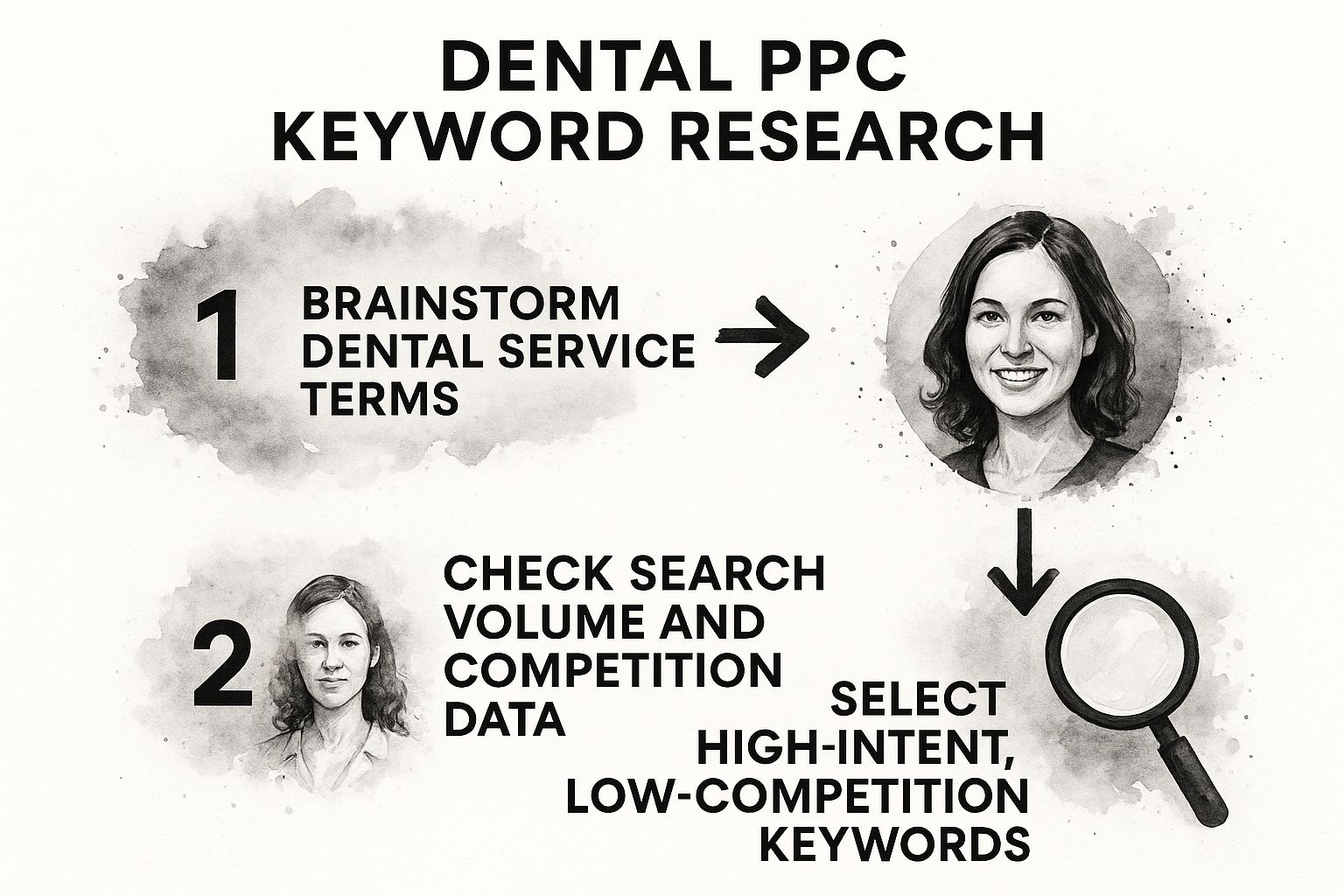
As the graphic shows, this is a systematic process. You prioritize keywords with strong commercial intent to ensure your budget is spent on clicks most likely to turn into actual patients.
To put this into practice, organize your keywords into tightly themed ad groups based on the services you offer. This structure is key because it ensures your ads are hyper-relevant to what the user searched for. Google rewards this relevance with higher Quality Scores and lower costs per click.
Here’s a sample structure for different services:
- General Dentistry:
dentist near mefamily dentist in [Your City]new patient dental exam special
- Cosmetic Dentistry:
teeth whitening [Your Neighborhood]cost of porcelain veneersinvisalign provider near me
- Emergency Services:
emergency dentist open weekendschipped tooth repair [Your City]urgent dental care now
Key Takeaway: Your campaign’s success hinges on targeting the right people with the right message at the exact moment they need you. By focusing on high-intent, localized keywords, you filter out casual researchers and connect directly with potential patients ready to pick up the phone.
Don't Forget Negative Keywords
Just as important as choosing what to target is deciding what not to target. Negative keywords are terms you add to your campaign to prevent your ads from showing for irrelevant searches. This simple step is absolutely crucial for protecting your budget and improving campaign efficiency.
For instance, a private practice would want to add negative keywords like "free," "cheap," or "dental school clinic" to avoid clicks from individuals who are not a good fit.
Make it a habit to regularly review your search term report in Google Ads. This report shows you exactly what people typed before clicking your ad, uncovering new negative keywords to add. This ongoing refinement ensures every dollar you spend is working to grow your practice.
Creating Ads and Landing Pages That Convert Patients
Getting a potential patient to click your ad is just the opening move. The real win in any PPC for dentists campaign is turning that click into a scheduled appointment. This is where your ad copy and landing page must work in perfect harmony.
A person frantically searching for "emergency toothache relief" is in a completely different headspace than someone casually researching "cosmetic veneers cost." Your ad needs to speak directly to their specific situation, reflecting that urgency or thoughtful consideration.
You must quickly answer the question, "Why should I choose your practice?" This is your Unique Selling Proposition (USP), and it's what will make you stand out from other dentists on the search results page.
Writing Ad Copy That Connects
Great ad copy isn't about listing every service you offer; it’s about empathy and clear benefits. It’s about solving the searcher’s problem, right now. Focus on one powerful message that directly aligns with the keywords you're targeting.
What makes your practice different? Do you offer anxiety-free sedation dentistry? Are you known for flexible, no-interest payment plans? Those are the hooks that grab attention.
Here are a few examples of benefit-driven ad headlines that perform well:
- For Emergencies: "24/7 Emergency Dentist | Get Fast Pain Relief"
- For Cosmetics: "Your Dream Smile Is Waiting | Free Invisalign Scan"
- For General Care: "Get Your $99 New Patient Exam & Cleaning"
Leveraging Ad Assets for Maximum Impact
Think of Google Ads Assets (formerly Ad Extensions) as your secret weapon. They allow you to pack more valuable information into your ad without using up the limited character count in your main copy. In short, they give users more reasons to click your ad instead of a competitor's.
When used correctly, assets build instant trust and provide shortcuts for users to take action.
- Sitelink Assets: Perfect for adding direct links to high-value pages like "Our Services," "Meet The Team," or "New Patient Specials."
- Call Assets: A must-have for mobile users, this places a clickable phone number directly in your ad, making it simple to call your front desk.
- Location Assets: By syncing with your Google Business Profile, this shows your practice's address, helping local searchers see how convenient you are.
- Image Assets: A picture is worth a thousand words. Add compelling photos of your modern office or friendly staff to make your text ad stand out.
By using assets, you're not just creating an ad; you're creating a mini-profile for your practice directly in the search results, increasing both visibility and click-through rates.
The Anatomy of a High-Converting Landing Page
So, they clicked. Now what? Sending them to your generic homepage is one of the biggest—and most expensive—mistakes in dental PPC. You absolutely need a dedicated landing page. It's non-negotiable.
This page should have one goal: getting the visitor to take a specific action, whether it's calling your office or filling out an appointment request form. Every element, from the headline to the button color, must support this single objective.
Your landing page must feel like a seamless continuation of the ad they just clicked. The message, offer, and overall feel should be perfectly aligned. Our team lives and breathes this philosophy, as you can see in our guide to professional website design and development services.
Core Elements of a Winning Dental Landing Page
To maximize the value of your ad spend, ensure your landing page includes these critical components:
- A Compelling, Benefit-Focused Headline: The headline must echo the promise of your ad. If the ad offered "Same-Day Crown Appointments," the landing page should say something very similar right at the top.
- A Simple, Above-the-Fold Form: Don't make potential patients hunt for your contact form. Place it at the top of the page and ask only for essential information: name, phone, and email.
- A Click-to-Call Phone Number: Your phone number needs to be prominent and clickable on mobile devices. With over 60% of searches happening on mobile, this is critical.
- Authentic Social Proof: Build trust with real patient testimonials, video reviews, or star ratings from Google. This shows you're a credible choice.
- A Clear Call-to-Action (CTA): Your buttons need to prompt action. Use direct language like "Book Your Free Consultation Now" instead of a passive word like "Submit."
Remember, converting these clicks often comes down to a phone call. To ensure your PPC investment turns into new patients, consider how a professional dental office answering service can help manage the new call volume, ensuring no lead is ever wasted.
Managing Your Dental PPC Budget and ROI
Let's talk numbers. Running a PPC for dentists campaign is a direct investment in your practice's growth, but you need a firm handle on your budget and a sharp eye on your returns to make it profitable. Mismanaging ad spend is one of the fastest ways for a great practice to lose faith in an incredibly powerful marketing channel.
The first question every dentist asks is, "How much should I spend?" There's no magic number, because a smart budget is built around your specific goals. Are you looking to fill a few empty slots, or are you aggressively trying to attract 30 new high-value implant patients this quarter? Your ambition dictates your initial investment.
From there, you must analyze your local competition. A dentist in a crowded city like New York or Los Angeles will need a more competitive budget to get noticed compared to a practice in a smaller town with fewer players bidding on the same keywords.
Decoding Key Financial Metrics
To know if your campaign is working, you must get comfortable with a few core metrics. These numbers are the vital signs of your campaign's financial health, telling you exactly where your money is going and what it’s bringing back.
Here are the essentials to watch:
- Cost-Per-Click (CPC): The exact price you pay each time someone clicks your ad. This is the foundational cost of your campaign.
- Cost-Per-Acquisition (CPA): Your total cost to get one new patient lead (like a phone call or a form submission). Calculated by dividing total ad spend by the number of leads.
- Return on Ad Spend (ROAS): The ultimate measure of profitability. It shows how much revenue you're generating for every dollar spent on ads. A 4:1 ROAS means you made $4 for every $1 you invested.
Understanding these numbers changes your perspective. You stop seeing PPC as an expense and start seeing it as a predictable, scalable growth engine.
Setting Realistic Budget Expectations
The dental industry is competitive, and that’s reflected in advertising costs. Recent data shows that the average cost-per-click for high-value dental keywords now sits between $6.50 and $9.75. While conversion rates have improved to around 4.2%, the cost to acquire a new patient can fall anywhere from $175 to $325, depending on your location and specialty.
Despite those costs, well-managed campaigns can see a powerful return on investment, often in the 300% to 500% range. This confirms PPC's value as a true profit center for dental practices. You can dig into more of these dental advertising benchmarks on elevatedds.com.
This data highlights the importance of a strategic, data-driven approach. You can't just throw money at ads and hope for the best.
A common mistake is setting a budget that's too low to gather meaningful data. An effective PPC campaign needs enough runway to test, learn, and optimize. Starting with a budget that allows for at least 10-20 clicks per day is a solid baseline for most local campaigns.
A Practical Example of Calculating ROI
Let's break down how this works in a real-world scenario.
Imagine your practice spends $2,000 on a Google Ads campaign in one month. That campaign generates 40 new patient phone calls and form submissions. Of those 40 leads, your front desk successfully books 10 new patients.
Here's the math:
- Your Cost-Per-Acquisition (CPA) is $2,000 / 40 leads = $50 per lead.
- Your Cost-Per-New-Patient is $2,000 / 10 patients = $200 per new patient.
Now, for the exciting part. If the average lifetime value of a new patient for your practice is $1,500, you spent $2,000 to generate $15,000 in potential lifetime revenue ($1,500 x 10). That’s a fantastic return that justifies every dollar spent and makes a clear case for scaling your investment.
Fine-Tuning and Scaling Your PPC Campaigns
Launching a PPC campaign for your dental practice is a great start, but real, sustainable growth comes from what you do after the launch. This is all about continuous optimization. Think of it less like flipping a switch and more like tending a garden—it needs constant attention to flourish.
The most successful dental practices treat their campaigns as living assets. They are always analyzing data, always testing, and always adapting. This mindset is what ensures every dollar spent is working hard to get new patients in the chair.
Get Your Hands Dirty with Campaign Data
Your campaign data is a goldmine, but you have to be willing to dig. The first place to look is the search term report. This report is invaluable because it shows you the exact phrases people typed into Google right before clicking your ad. Reviewing this regularly is non-negotiable for preventing wasted spend.
You'll quickly discover you're paying for clicks from people searching for terms like "dental assistant jobs" or "free dental clinic." These aren't potential patients; they are budget leaks.
This is where your negative keyword list becomes your best friend. By adding terms like "jobs," "school," and "free," you're telling Google, "Don't show my ads to these people." It's one of the fastest ways to make your budget stretch further.
Pro Tip: Don't just build a negative keyword list and forget it. Make it a weekly or bi-weekly habit to review your search terms. New, irrelevant search patterns emerge all the time, and staying on top of them is crucial for protecting your ROI.
Always Be Testing
In PPC, complacency is your worst enemy. You should constantly be A/B testing different parts of your campaign to see what resonates with potential patients. Even minor changes can lead to significant improvements in appointment bookings.
- Test Your Ad Copy: Try a headline promoting a special offer ("$99 New Patient Special") against one highlighting a unique benefit ("Anxiety-Free Sedation Dentistry").
- Vary Your Calls-to-Action (CTAs): Does "Book Your Appointment" outperform "Schedule a Free Consultation"? The language you use matters.
- Tweak Your Landing Pages: Test different headlines, move the contact form, or swap out the main image. You might be surprised to find that a photo of your smiling team converts better than a picture of your state-of-the-art office. The data will reveal the answer.
This is how a good campaign becomes a consistent patient-generation machine. At Adfuel, our entire approach to marketing management is built on this foundation of relentless, data-driven optimization.
Advanced Strategies to Bring Patients Back
Here's a hard truth: most people who land on your website for the first time won't book an appointment. That's normal. But it doesn't mean they're a lost cause. This is exactly what retargeting was made for.
Retargeting allows you to show specific ads to people who have already visited your site but didn't convert. It's a fantastic way to stay on their radar. For example, you can show a subtle reminder ad on Facebook or other websites to someone who viewed your dental implants page, keeping your practice top-of-mind while they consider their options.
As you get deeper into optimization, it helps to know the industry benchmarks. Recent data shows the click-through rate (CTR) for dental ads sits just under the all-industry average of 6.66%, largely because of how competitive the space is. To win, you have to get specific with locally-targeted ads for high-value services like cosmetic dentistry or emergency care. In competitive markets, the cost per lead can easily top £80, making precise campaign management absolutely critical to avoid burning through your budget. You can learn more about these 2025 dental PPC benchmarks on Dental Design.
How to Scale Your Success the Smart Way
Once you've dialed in a campaign that's consistently delivering a positive ROI, it's time to think bigger. But scaling isn't just about cranking up your budget; it’s about having a smart plan to handle the subsequent growth.
Before increasing your ad spend, ask a crucial question: is my front desk ready for this? A flood of new patient calls can easily overwhelm an unprepared team, leading to missed calls, frustrated callers, and wasted ad spend.
Here’s how to scale intelligently:
- Expand Your Map: Start targeting adjacent zip codes or nearby towns.
- Broaden Your Keywords: Add more high-intent keywords for the specific services you want to promote more heavily.
- Double Down on Winners: Reallocate more budget into the ad groups and keywords that are already your top performers.
Scaling is the reward for diligent optimization. By analyzing your data, testing everything, and ensuring your practice is ready for more business, you can turn your PPC campaign into a predictable, profitable engine that keeps your appointment book full.
Common Questions About PPC for Dentists
Diving into pay-per-click advertising always brings up questions. Investing in PPC for dentists is a significant decision, and it’s smart to get clarity before you jump in.
We field the same concerns from dental practice owners almost every day. To help, we’ve compiled the most common questions we hear, along with straightforward answers based on our experience.
How Much Should a Dental Practice Budget for PPC?
This is always the first question, and the honest answer is: it depends on your goals and location. There is no one-size-fits-all number.
As a starting point, a smaller practice in a less crowded market might see results with $1,500 to $3,000 per month. However, if you're in a dense, competitive city, you'll likely need to invest $5,000 to $10,000+ to gain meaningful traction.
The most important factor isn't the dollar amount itself, but whether the budget is large enough to gather meaningful data. A budget that's too small won't generate enough clicks to determine what's working, making it impossible to optimize for a positive return on investment.
Instead of viewing it as a cost, think of it as an investment tied to your growth targets. Are you looking to book five new high-value patients a month, or fifty? Your budget should scale with your ambition.
How Long Until I See Real Results From My Ads?
The great thing about PPC is its immediacy, unlike SEO which can take months to build momentum. Your ads can appear at the top of Google search results within hours of launching.
But "results" can mean a few different things. You'll see website clicks and traffic almost instantly. Achieving a consistent, predictable flow of high-quality patient leads, however, takes time and refinement.
Here’s a realistic timeline:
- Month 1: This month is about data collection and initial testing. We gather crucial information on which keywords, ad copy, and landing pages perform best. You'll get leads, but the main focus is learning.
- Months 2-3: We shift into the optimization phase. Using data from month one, we begin fine-tuning the campaigns—adding negative keywords, pausing underperforming ads, and allocating more budget to what’s working. Your cost per lead should start to decrease.
- Month 4 and beyond: By now, the campaign should be a well-oiled machine, delivering a predictable number of new patient leads and a positive, scalable ROI.
Can I Just Run PPC Ads to My Homepage?
Technically, yes. But it's one of the biggest and most expensive mistakes you can make. Sending paid traffic to your general homepage is like setting your marketing budget on fire.
Your homepage is designed for a broad audience, with different links, service pages, and navigation options. A potential patient who just clicked an ad for "emergency dental implants" can easily get distracted and leave your site.
Dedicated landing pages are non-negotiable for a successful PPC campaign. A good landing page has a single, focused goal: to get the visitor to take one specific action, like calling your office or filling out a booking form. This laser focus dramatically increases conversion rates and ultimately lowers your cost to acquire a new patient.
Is PPC Better Than SEO for Dentists?
This isn’t an "either/or" situation. The most dominant dental practices use both PPC and SEO together, as they serve different but highly complementary purposes.
- PPC is for immediate results. It’s the tool you use to generate new patient leads right now, targeting people actively searching for your services.
- SEO is for long-term authority. It’s a marathon, not a sprint. SEO builds your practice's organic presence, establishing trust and credibility over time to bring in sustainable, "free" traffic.
Think of PPC as a faucet you can turn on for an instant flow of leads, while SEO is the well you build to provide a steady supply for years to come. To truly dominate your local market, you need both.
The data supports this. Industry stats show that around 35% of all online traffic to dental offices is driven by paid ads. And with 71% of patients conducting online research before booking an appointment, a strong presence in both paid and organic search is critical. You can see more insights from the latest patient acquisition trends on orthomarketing.com.
Want to simplify your ad campaigns and get a predictable stream of new patients? The team at Adfuel Inc specializes in creating and managing high-performance Google Ads campaigns for dental practices. Discover our fully managed solutions today. Book a free demo with us at https://goadfuel.com/book-demo or send us an email at hello@goadfuel.com for more information.


