

Ever wonder what happens to the 98% of visitors who leave your website without filling out a form or booking a call? For most real estate agents and local businesses, that lost traffic represents a huge missed opportunity—and a significant drain on the marketing budget. You're spending good money to attract visitors who simply vanish.
But what if you could have a second conversation with those warm prospects? This is the core of what is retargeting advertising is all about. It’s a strategic way to reconnect with people who have already shown interest in your services, turning missed opportunities into measurable conversions. It’s your chance to follow up, build trust, and gently guide them back when they're ready to act.
Giving Your Marketing a Powerful Second Chance
Imagine a potential client lands on your real estate website to view a property listing in Boca Raton. Life gets in the way—their phone rings, they get distracted, and they close the tab. Without retargeting, that lead is gone. But with a smart strategy, you can show them an ad for that exact property an hour later while they scroll through their social media feed. It’s a game-changer.

This simple follow-up isn't about casting a wider net; it's about strategically re-engaging those who are already familiar with you and just need a little nudge.
Turning Missed Opportunities Into Conversions
A well-executed retargeting campaign accomplishes several critical goals:
- Boosts Brand Recall: It keeps your name and services top-of-mind, so when prospects are ready to make a decision, they think of you first.
- Increases Conversion Rates: It's a proven fact. Website visitors who see retargeting ads are 70% more likely to convert on a future visit.
- Builds Trust and Familiarity: Seeing your brand again creates a sense of authority and reliability. These gentle reminders subtly position you as the go-to expert in your field.
At its core, retargeting is about marketing efficiency. You stop spending all your time and money chasing cold leads and instead focus your budget on a warm audience that has already raised its hand.
For a local service business, this could mean showing a special discount to someone who visited your pricing page. For a realtor, it’s about reminding a prospect of the dream home they were just looking at. This guide will break down exactly how this powerful strategy works and how you can put it into action to bring back lost leads and get a much better return on your ad spend.
How Does Retargeting Advertising Actually Work?
Have you ever looked at a product online, only to see an ad for it pop up on a different website moments later? It’s not magic, but a clever marketing technology designed to re-engage people who have already shown interest in what you offer. The whole process hinges on two simple tools: a tracking pixel and a cookie.
Think of the tracking pixel as a tiny, invisible piece of code placed on your website. When someone visits one of your pages, that code "fires" and discreetly places an anonymous browser cookie on their device. This cookie is just a small text file that acts as an identifier, marking that user as someone who has visited your site before. The process is entirely anonymous; it doesn’t grab names or emails, only behavioral data like which pages they visited.
This image gives you a great visual breakdown of the user's journey.
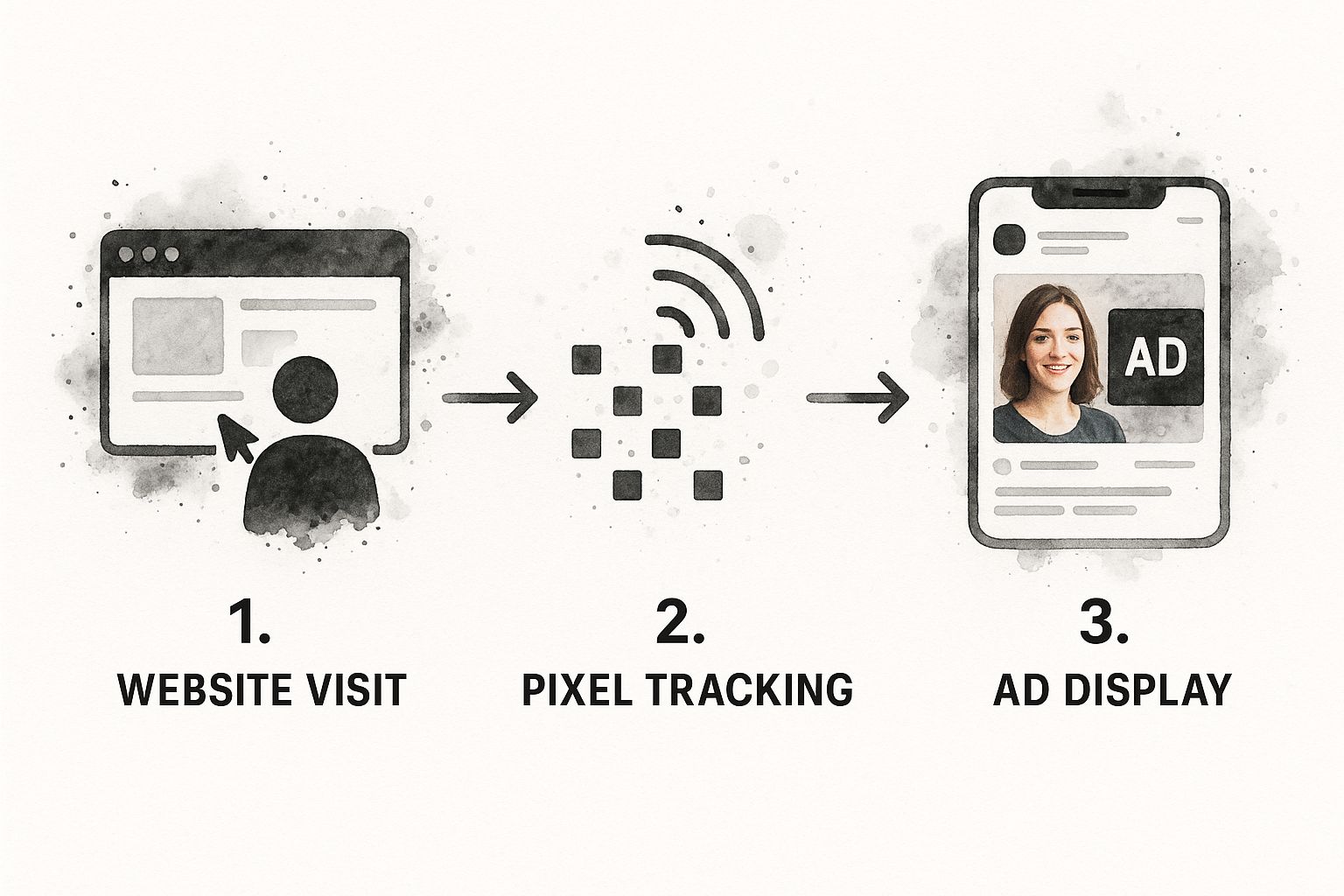
As you can see, it's a straightforward loop: a user visits your site, the pixel tags them, and your ads can then find them later as they browse other sites and social media platforms.
The Retargeting Process Step by Step
This table breaks down how a user's initial visit turns into a targeted ad impression.
| Step | Action | Technology Used | Example Scenario |
|---|---|---|---|
| 1 | A user visits your website or a specific page. | Your Website | A potential client lands on your "Kitchen Remodeling Services" page. |
| 2 | An invisible pixel on your site fires. | Tracking Pixel (JavaScript) | The pixel from your Google Ads account activates in their browser. |
| 3 | The pixel drops an anonymous cookie onto the user's device. | Browser Cookie | Their browser now holds a cookie identifying them as interested in kitchen remodels. |
| 4 | The user leaves your site and browses elsewhere. | Ad Network Partner Sites | Later, they're reading a news article on a site that's part of Google's network. |
| 5 | Your retargeting platform recognizes the cookie. | Ad Platform | Google's system spots the cookie and knows this user is on your "kitchen remodel" list. |
| 6 | The platform serves them your targeted ad. | Targeted Ad Display | They see your ad: "Dreaming of a New Kitchen? Get a Free Estimate Today!" |
This entire cycle happens in milliseconds, creating a seamless and relevant experience that keeps your business top of mind.
Building Your Custom Audience Lists
This is where retargeting gets really powerful. Instead of showing the same generic ad to every past visitor, you can segment people into highly specific audience lists based on their actions.
Here are a few actionable examples:
- Property Viewers: A real estate agent could build a list of everyone who viewed the listing for "123 Main Street" and retarget them with ads featuring a video tour of that exact home.
- Pricing Page Visitors: A local contractor can create an audience of users who checked out their pricing page and show them an ad with a special 10% discount to nudge them toward booking a consultation.
- Blog Readers: If someone reads your blog post on "First-Time Homebuyer Mistakes," you can retarget them with an invitation to a free webinar on the same topic.
This level of detail lets you craft messages that speak directly to what a user has already shown interest in. Your ads stop feeling like ads and start feeling like genuinely helpful next steps.
Re-Engaging High-Intent Prospects
One of the most valuable uses of retargeting is winning back lost leads and sales. Industry data shows that, on average, nearly 70% of online shopping carts are abandoned. Retargeting is the perfect tool to combat this, letting you reconnect with people who were on the verge of converting but got sidetracked. A well-executed campaign can lower abandonment rates significantly. To see more figures like this, you can find a wealth of retargeting statistics from industry reports.
The core idea is simple: your advertising dollars go so much further when you're talking to a warm audience. By segmenting visitors based on their actions, you make sure the right message reaches the right person at the perfect moment.
Measuring the Real-World Benefits of Retargeting
For any small business owner or real estate professional, every dollar in the marketing budget has to pull its weight. A well-crafted retargeting strategy isn't just about brand awareness; it's about generating measurable, results-oriented outcomes that impact your bottom line.
The true value of retargeting is its efficiency. You stop chasing cold traffic and start focusing your ad spend on a pre-qualified audience that already knows you. This is what drives the impressive results that make retargeting an essential tool for serious lead generation.
Higher Conversion Rates and Better Engagement
The most immediate benefit you'll see from retargeting is a significant jump in conversion rates. You’re simply reconnecting with people who are already familiar with your brand, which makes them far more likely to take that next step.
The numbers don't lie. Retargeted ads have an average click-through rate (CTR) of 0.7%, which is a massive ten times higher than the typical 0.07% CTR of standard display ads. This boost in engagement translates directly into more website visits and, ultimately, more conversions. In fact, some studies show retargeting can lift conversion rates by as much as 150%.
To really make the most of this, it's worth digging into the details of what drives clicks. For a deeper dive, check out our guide on how to improve click-through rates in your campaigns.
Lower Cost Per Acquisition
Because you're targeting people who are much more likely to convert, your ad spend immediately becomes more effective. This efficiency directly lowers your Cost Per Acquisition (CPA)—the amount it costs you to land a new customer or a qualified lead. You’re no longer paying to reach thousands of people who will never be interested; you're investing in a smaller, highly relevant group.
Retargeting maximizes your return on ad spend (ROAS) by ensuring your message lands with people who are most likely to become customers, not just casual browsers.
Building Powerful Brand Recall and Trust
Consistency is everything when it comes to building a memorable brand. Retargeting gives you a subtle but constant presence in front of potential clients as they go about their day online. Every time they see your ad, it builds a powerful sense of familiarity and trust.
Think about it in a real-world scenario:
- The Setup: A Boca Raton real estate agent runs an ad for a stunning new luxury condo. Someone clicks the ad, browses the property details on the website, but gets distracted and leaves without filling out the contact form.
- The Retargeting: Over the next week, that same person sees beautiful, tasteful ads for that specific condo while scrolling through Facebook or reading the news.
- The Payoff: When they’re finally ready to schedule a viewing, whose name pops into their head first? The agent who has stayed top-of-mind. That consistent, gentle follow-up has positioned them as the clear expert for that property.
This process ensures that when a lead is ready to make a move, your business isn’t just an option—it’s the obvious choice.
Choosing the Right Retargeting Strategy for Your Goals
An effective retargeting campaign is all about delivering a specific, relevant message to a specific group based on their initial interaction with you. Answering what is retargeting advertising is less about a single tactic and more about a whole menu of options. Choosing the right one is what makes your follow-up feel helpful and timely, not just repetitive noise.
Pixel-Based Retargeting for Brand Awareness
This is the bread and butter of retargeting. It uses the tracking pixel we talked about to show ads to anyone who has recently stopped by your website. It’s a broader approach but incredibly effective for making sure your brand stays top-of-mind.
- Best For: General brand recall and encouraging a second look.
- Example: A local realtor in Boca Raton might use pixel-based retargeting to show ads featuring their brokerage and recent sales to anyone who has visited their homepage in the last 30 days.
List-Based Retargeting for Nurturing Leads
Here, the approach is more personal. Instead of targeting anonymous website visitors, you’re targeting people from a specific list you already have—think email newsletter subscribers or your CRM database. You upload this list to a platform like Meta, which then matches the emails or phone numbers to user profiles.
- Best For: Re-engaging past clients, upselling existing customers, or warming up a cold lead list.
- Example: A local roofing contractor could upload their database of past customers and show them an ad for a seasonal inspection special, generating repeat business from an audience that already trusts them.
Dynamic Retargeting for Personalized Follow-Ups
This is a game-changer for businesses with many different products or services. Dynamic retargeting automatically shows ads featuring the exact item, property, or service a user just viewed on your site.
This strategy closes the gap between someone showing interest and actually taking action. It’s the digital equivalent of a helpful store assistant saying, "Here's that beautiful home you were looking at earlier."
It requires more setup—you need a product or service feed connected to your ad platform—but the payoff is massive, particularly in fields like real estate.
Video Retargeting for Engaging Viewers
If you're creating video content, this is a must. Platforms like Meta and YouTube let you build audiences based on how people engage with your videos. For instance, you can target anyone who watched at least 50% of your latest property tour.
- Best For: Building a deeper connection with an audience that's already shown interest.
- Example: After running a video tour of a new listing, a real estate agent can retarget everyone who watched most of it with a follow-up ad that nudges them to "Book a Private Showing."
Choosing Your Retargeting Strategy
Each of these strategies serves a distinct purpose. The key is to match the method to the marketing goal.
| Strategy Type | Best For | Example Use Case (Realtor) | Example Use Case (Local Service) |
|---|---|---|---|
| Pixel-Based | General brand awareness and keeping your name top-of-mind with recent site visitors. | Showing ads for your brokerage to anyone who visited your website in the last 30 days. | A plumber showing general service ads to anyone who recently viewed their 'emergency repairs' page. |
| List-Based | Nurturing existing leads, re-engaging past clients, or upselling current customers. | Uploading a list of past seller clients and showing them ads about market updates or referral bonuses. | A lawn care company uploading a customer list to offer an exclusive "add-on aeration service" discount. |
| Dynamic | E-commerce, real estate, or any business with a large inventory of distinct offerings. | A user viewed a specific 4-bedroom house; they now see an ad featuring that exact property. | An HVAC company shows an ad for the specific AC unit a visitor was looking at on their products page. |
| Video | Building rapport with an already engaged audience and moving them to the next step. | Retargeting viewers who watched 75% of a listing video with an ad for an open house event. | A personal trainer retargets viewers of their "5-minute workout" video with an offer for a free consultation. |
Ultimately, the goal isn't just to follow people around the internet. It's about continuing a conversation you've already started. By aligning your approach with your specific goals, you can learn more about how to retarget like a pro and turn casual interest into tangible business results.
Executing Your Retargeting Campaigns Like a Pro
A great strategy is only as good as its execution. When done right, a retargeting campaign feels helpful and timely—not intrusive or repetitive.

This takes a thoughtful touch, from how you manage your audience lists to the creative you put in front of them. By sticking to a few best practices, you can make sure your ads build trust and drive action, rather than just causing ad fatigue.
Segment Your Audiences Thoughtfully
One of the biggest mistakes businesses make is showing the exact same ad to every single person who has ever visited their website. Audience segmentation is where the magic really happens.
- Homepage Visitors: This is your broadest audience. Consider them lukewarm. Retarget them with ads that build general brand awareness, like client testimonials or content that highlights what makes you different.
- Specific Service/Product Page Viewers: These folks have shown clear interest. Hit them with ads that zero in on the benefits of that specific service, or maybe a video walkthrough of the exact property they were checking out.
- Cart Abandoners or Form Starters: This is your low-hanging fruit—your highest-intent audience. Your ads here should be designed to get them over the finish line. Address common objections, offer a small incentive, or create a little urgency to bring them back.
For real estate agents, getting this granular is non-negotiable. If you want to dive deeper into targeting specific buyer types, check out our guide on running effective Facebook ads for real estate leads.
Control Ad Frequency to Avoid Fatigue
Have you ever felt like you're being stalked across the internet by the same ad? That’s the direct result of a business forgetting to set a frequency cap. Bombarding someone with the same message over and over is the fastest way to turn a potential customer into someone who is actively annoyed by your brand.
Setting a frequency cap is crucial. It limits how many times one person sees your ad in a given timeframe. This simple step keeps your message helpful instead of harassing.
As a rule of thumb, limiting impressions to 3-5 views per user per week is a solid starting point. You can always tweak this based on how the campaign is performing.
Align Your Creative with the User Journey
The ad itself—the image, the video, the copy—has to match where that person is in their journey. A casual homepage visitor might engage with a slick brand video. But someone who viewed a very specific service page needs an ad that speaks directly to that service.
Let's say a local plumber is retargeting a visitor who looked at their "emergency leak repair" page. The ad copy should be something like, "Need a fix, fast? We offer 24/7 emergency service." This direct, relevant messaging proves you understand their problem and have the solution.
Where is Retargeting Headed? (And How to Stay Ahead)
With digital privacy becoming a major topic of conversation, it’s easy to wonder if retargeting’s days are numbered due to the phase-out of third-party cookies.
The truth is, retargeting isn't going away. It's evolving. This shift is less of a roadblock and more of a move toward building more transparent, trust-based marketing strategies that perform better in the long run. The future is all about first-party data—the information your customers and prospects share with you directly. This forces us to build real relationships instead of just chasing anonymous clicks.
A Privacy-First Future is a Better Future
New technologies already allow us to run powerful retargeting campaigns that respect user privacy. Tools like Meta's Conversion API and Google's Privacy Sandbox are designed to work with aggregated, anonymous data, which means we can still reach the right people without needing to track them individually across the web.
The goal isn't to find sneaky workarounds for privacy rules. It's about building campaigns on a solid foundation of user trust and consent. When people opt-in to your marketing, the engagement you get is a hundred times more valuable.
The digital ad market is still booming. Global spending is on track to blow past $1 trillion by 2025. Retargeting will absolutely remain a key piece of that puzzle. Businesses that adapt by partnering with experts who understand this new terrain will be the ones who come out on top. For a deeper dive, check out these insights on global ad spending trends and what they mean for marketers.
A Few Lingering Questions About Retargeting
Even the best-laid plans come with a few questions. Let's tackle some of the most common ones we hear about retargeting, so you can move forward with total clarity.
Is Retargeting the Same as Remarketing?
Great question. You'll often see these two terms used interchangeably, and in today's world, they pretty much are. They both aim to reconnect with people who've already shown interest in your brand.
Technically, there used to be a slight difference. "Remarketing" was Google’s preferred term, usually tied to re-engaging people through search ads or email. "Retargeting" was the term platforms like Facebook used for showing display ads to past website visitors. Now, the distinction has faded, and you can safely use either.
What’s the Price Tag on a Retargeting Campaign?
This is where retargeting really shines—it’s incredibly cost-effective. You're talking to a small, highly interested audience, not shouting into the void. That focus naturally leads to a much better return on ad spend (ROAS).
You'll generally pay in one of two ways:
- Cost Per Click (CPC): You pay only when someone actually clicks on your ad.
- Cost Per Mille (CPM): You pay a flat rate for every 1,000 times your ad is shown.
Because you’re reaching a warm audience, your CPC and the overall cost to land a customer are almost always lower than with campaigns targeting a cold audience.
Can I Run Retargeting on Both Google and Facebook?
Absolutely, and you probably should. Think of them as two different but equally powerful tools in your toolbox. Google lets you reach people across its massive Display Network, on YouTube, and when they’re searching again. Meanwhile, Meta (Facebook and Instagram) is perfect for catching people in a more relaxed, social mindset. Using both maximizes your chances of staying top-of-mind.
Does Retargeting Respect Privacy Laws?
Yes, when done correctly. Modern retargeting was designed with privacy in mind. The process is anonymous; it tracks browser cookies, not people. It doesn’t collect personal details like your name or email address. It’s all about behavior—what someone did—not who they are. As privacy rules change, ad platforms are constantly updating their tech to ensure your campaigns can still be effective while staying fully compliant with the latest regulations.
Want to simplify your ad campaigns? Discover our fully managed Meta and Google Ads solutions. Book a free demo with us or send us an email at hello@goadfuel.com for more information.


